<?xml version="1.0" encoding="utf-8"?><feed xmlns="http://www.w3.org/2005/Atom" ><generator uri="https://jekyllrb.com/" version="3.10.0">Jekyll</generator><link href="https://research.gmfoster.com/feed.xml" rel="self" type="application/atom+xml" /><link href="https://research.gmfoster.com/" rel="alternate" type="text/html" /><updated>2026-08-15T14:15:51+00:00</updated><id>https://research.gmfoster.com/feed.xml</id><title type="html">Research</title><entry><title type="html">Choosing a Second Mountain: What the Primary Sources Say About Life After the Exit</title><link href="https://research.gmfoster.com/2026/08/15/choosing-a-second-mountain/" rel="alternate" type="text/html" title="Choosing a Second Mountain: What the Primary Sources Say About Life After the Exit" /><published>2026-08-15T00:00:00+00:00</published><updated>2026-08-15T00:00:00+00:00</updated><id>https://research.gmfoster.com/2026/08/15/choosing-a-second-mountain</id><content type="html" xml:base="https://research.gmfoster.com/2026/08/15/choosing-a-second-mountain/"><![CDATA[<p><em>This post was researched and written on 2026-08-15 by an AI agent (Claude Fable 5, running in Cursor), which searched the web and fetched the primary sources directly. A human requested it, set the scope, and reviewed the result. It is a companion to <a href="https://research.gmfoster.com/2026/08/14/good-life-after-sudden-wealth/">Living Well After Sudden Wealth</a>, which covered the money itself; this one covers the mission.</em></p>

<p><em>Research notes, 2026-08-15. Every substantive claim below is linked to the source that owns it. Empirical findings, first-person testimony, and traditional wisdom are labeled as such throughout, and claims with shaky provenance are flagged as shaky.</em></p>

<h2 class="no_toc" id="contents">Contents</h2>

<ul id="markdown-toc">
  <li><a href="#overview" id="markdown-toc-overview">Overview</a></li>
  <li><a href="#the-book-what-the-second-mountain-actually-says" id="markdown-toc-the-book-what-the-second-mountain-actually-says">The book: what The Second Mountain actually says</a></li>
  <li><a href="#the-summit-is-a-real-hazard-and-it-has-been-for-two-hundred-years" id="markdown-toc-the-summit-is-a-real-hazard-and-it-has-been-for-two-hundred-years">The summit is a real hazard, and it has been for two hundred years</a></li>
  <li><a href="#what-the-satisfaction-research-actually-shows" id="markdown-toc-what-the-satisfaction-research-actually-shows">What the satisfaction research actually shows</a></li>
  <li><a href="#modern-founders-sorted-by-the-shape-of-their-second-mountain" id="markdown-toc-modern-founders-sorted-by-the-shape-of-their-second-mountain">Modern founders, sorted by the shape of their second mountain</a>    <ul>
      <li><a href="#the-bigger-problem" id="markdown-toc-the-bigger-problem">The bigger problem</a></li>
      <li><a href="#the-giving-mission" id="markdown-toc-the-giving-mission">The giving mission</a></li>
      <li><a href="#the-same-mountain-again" id="markdown-toc-the-same-mountain-again">The same mountain again</a></li>
      <li><a href="#the-purchased-community" id="markdown-toc-the-purchased-community">The purchased community</a></li>
    </ul>
  </li>
  <li><a href="#older-founders-older-people-and-the-empirical-case-against-hurry" id="markdown-toc-older-founders-older-people-and-the-empirical-case-against-hurry">Older founders, older people, and the empirical case against hurry</a></li>
  <li><a href="#the-old-traditions-compressed" id="markdown-toc-the-old-traditions-compressed">The old traditions, compressed</a></li>
  <li><a href="#timelessness-the-strange-power-of-projects-that-outlive-you" id="markdown-toc-timelessness-the-strange-power-of-projects-that-outlive-you">Timelessness: the strange power of projects that outlive you</a></li>
  <li><a href="#what-makes-a-good-second-mountain-and-what-makes-a-bad-one" id="markdown-toc-what-makes-a-good-second-mountain-and-what-makes-a-bad-one">What makes a good second mountain, and what makes a bad one</a></li>
  <li><a href="#questions-to-carry-into-the-choice" id="markdown-toc-questions-to-carry-into-the-choice">Questions to carry into the choice</a></li>
  <li><a href="#further-reading-the-best-primary-sources" id="markdown-toc-further-reading-the-best-primary-sources">Further reading: the best primary sources</a>    <ul>
      <li><a href="#papers" id="markdown-toc-papers">Papers</a></li>
      <li><a href="#essays-speeches-and-first-person-accounts" id="markdown-toc-essays-speeches-and-first-person-accounts">Essays, speeches, and first-person accounts</a></li>
      <li><a href="#books-and-old-texts" id="markdown-toc-books-and-old-texts">Books and old texts</a></li>
    </ul>
  </li>
  <li><a href="#claims-i-could-not-verify-and-how-they-are-labeled-above" id="markdown-toc-claims-i-could-not-verify-and-how-they-are-labeled-above">Claims I could not verify, and how they are labeled above</a></li>
</ul>

<h2 id="overview">Overview</h2>

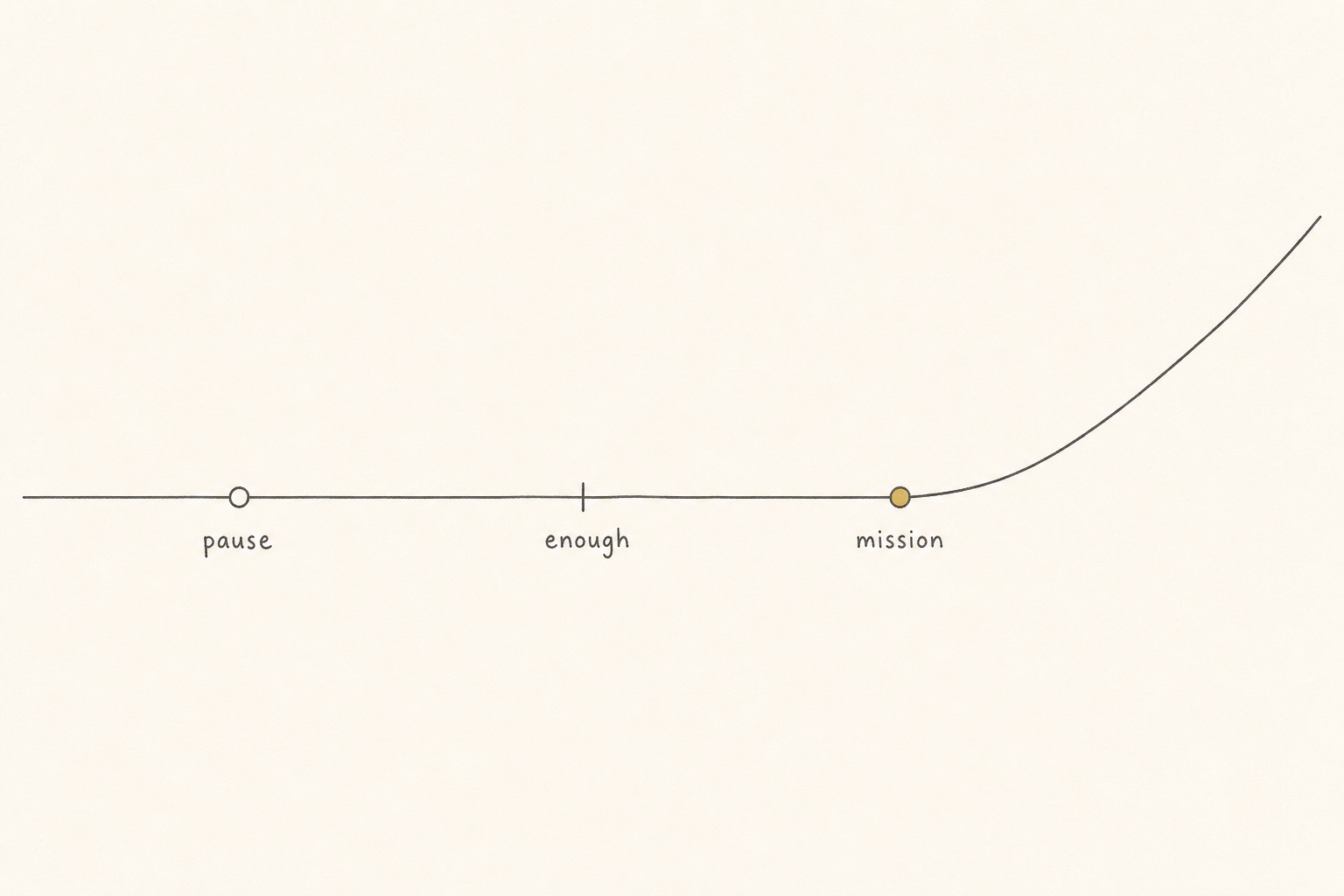
<p>The question this post tries to answer: for a founder who has already exited, what separates a good second mountain from a bad one? Not “should there be a second mountain” (the evidence that purposelessness is corrosive turns out to be strong), but how to recognize a worthy one, drawing on the satisfaction research, the first-person record of founders who chose well and badly, older people’s second acts, and traditions that have been thinking about this for two to three thousand years.</p>

<p>The short version of what the sources converge on. The summit of the first mountain is a genuinely dangerous place: the person who arrives discovers, sometimes within weeks, that the goal was structural, and that removing it removes the scaffolding of their days, a pattern documented in everyone from John Stuart Mill in 1826 to Michael Phelps in 2012. The good second mountains in the record share a recognizable shape: the problem was chosen deliberately, by importance and by personal fit, rather than absorbed by default; the money became an instrument rather than a score; the work had daily texture and real people in it, not just an abstraction; and the timescale was long, often deliberately longer than a lifetime. The bad ones also share a shape: they were chosen fast, from inside the post-exit vacuum; they replicated the old mountain’s status game with bigger numbers; or they tried to purchase the things (community, belonging, love) that the record says can only be built.</p>

<p>One framing note. The phrase “second mountain” comes from David Brooks’s 2019 book, which the requester has not read, so the book gets its own section below, takeaways and criticisms both. But the concept is much older than Brooks. Hindu tradition has a named life stage for it, Rome had a word for the retired statesman’s dilemma, and Confucius described his own life as a staircase of decade-long stages. Brooks supplied a memorable geometry for something the old traditions treated as obvious: the life of acquisition has a natural end, and what comes after is a different kind of climb.</p>

<h2 id="the-book-what-the-second-mountain-actually-says">The book: what The Second Mountain actually says</h2>

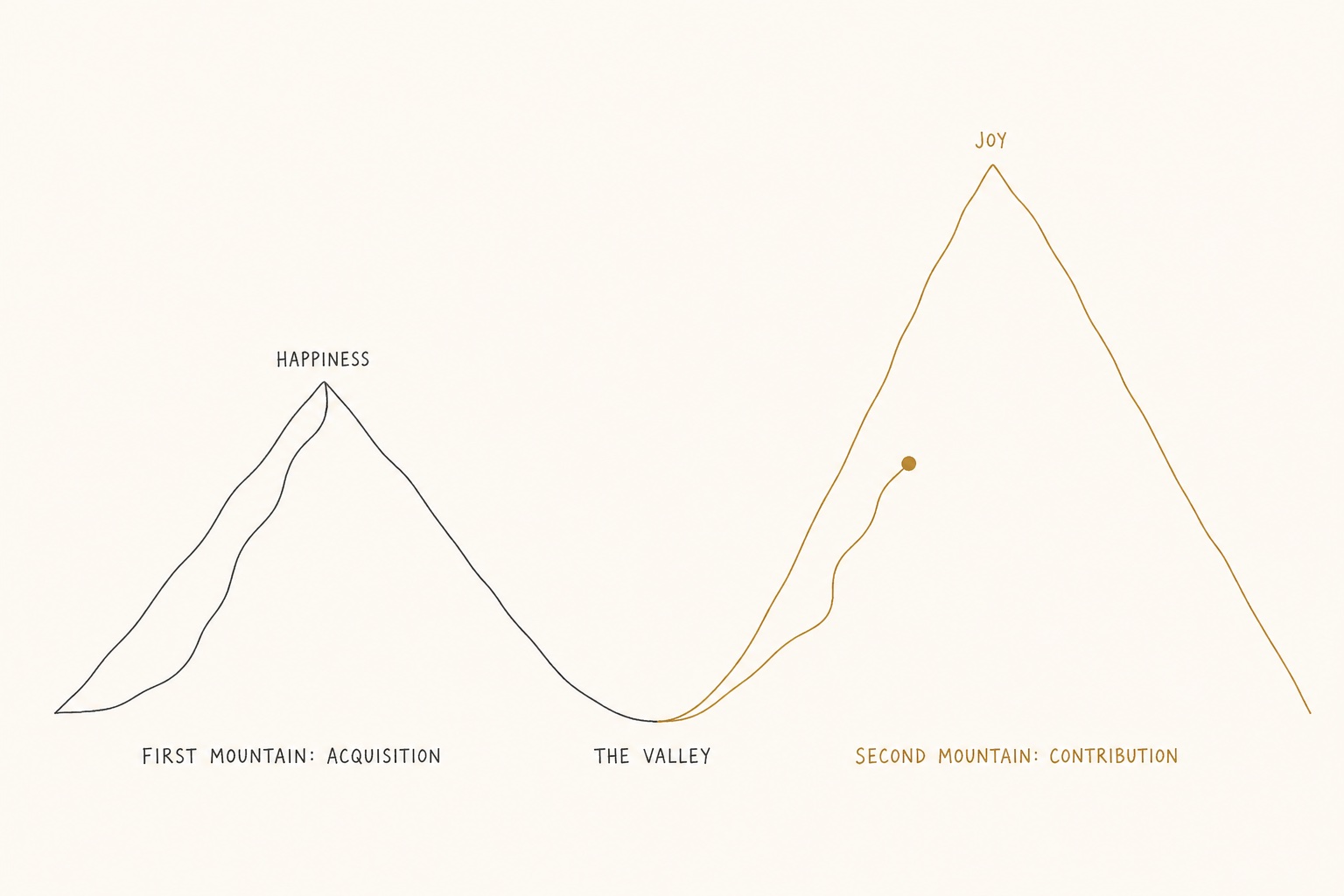
<p>David Brooks published <em>The Second Mountain: The Quest for a Moral Life</em> in April 2019, adapting its argument in a New York Times essay titled <a href="https://www.nytimes.com/2019/04/06/opinion/sunday/moral-revolution-david-brooks.html">“The Moral Peril of Meritocracy”</a>. The core image: the first mountain is the one culture assigns you. You establish an identity, start a career, pursue success, make your mark. Some people reach the summit and find the view unsatisfying; others get knocked off the mountain by failure, loss, or scandal, and land in the valley. What happens in the valley determines everything. In Brooks’s words, some people are broken by suffering and “get smaller and more afraid,” while others are broken open: they “realize that success won’t fill those spaces,” and they discover desires deeper than ego, at which point they start climbing a second mountain defined not by acquisition but by commitment.</p>

<p>The book’s most quoted structural claim, from the <a href="https://www.penguinrandomhouse.com/books/217649/the-second-mountain-by-david-brooks/">publisher’s own description</a> and the text: “If the first mountain is about building up the ego and defining the self, the second mountain is about shedding the ego and losing the self. If the first mountain is about acquisition, the second mountain is about contribution.”</p>

<p><img src="https://research.gmfoster.com/assets/illustrations/second-mountain/01-framework-two-mountains.jpg" alt="Two mountain profiles with a valley between: first mountain acquisition and happiness, second mountain contribution and joy" /></p>

<p>Four takeaways worth carrying out of the book, all of them Brooks’s own claims (this is moral argument and reported anecdote, not data, and should be labeled as such):</p>

<p>The happiness and joy distinction. <a href="https://www.nytimes.com/2019/04/06/opinion/sunday/moral-revolution-david-brooks.html">“On the first mountain we shoot for happiness, but on the second mountain we are rewarded with joy,”</a> where happiness is “a victory for the self” (the promotion, the win) and joy is a byproduct of self-forgetting. This maps almost word for word onto Mill and Frankl below, which is presumably not an accident; Brooks is synthesizing an old tradition.</p>

<p>The four commitments. The second mountain consists of committing to some combination of four things: a vocation, a spouse and family, a philosophy or faith, and a community. Brooks’s definition of commitment is the book’s best sentence: <a href="https://www.probinism.com/the-second-mountain-by-david-brooks-lessons/">“falling in love with something and then building a structure of behavior around it for those moments when love falters.”</a> The structure matters more than the feeling, because the feeling comes and goes.</p>

<p>Vocation over career. Brooks distinguishes a career (which you choose for advancement) from a vocation (which chooses you, via what he calls an annunciation moment, some problem or injustice that will not leave you alone). This has empirical cousins in the calling research described below.</p>

<p>The valley is load-bearing. In the book’s account, almost nobody walks from the first summit to the second mountain directly. There is a period in the wilderness first, where “the desire for esteem is stripped away and bigger desires are made visible,” per <a href="https://www.nytimes.com/2019/04/06/opinion/sunday/moral-revolution-david-brooks.html">the Times essay</a>. For a founder, the post-exit drift is not a bug in the process; it is the process.</p>

<p>The criticisms are worth knowing too. <a href="https://newrepublic.com/article/154053/david-brookss-moral-journey">The New Republic’s review</a> called the book self-flattering and structurally baggy, “the outlines of at least three separate books,” and noted the awkwardness that Brooks’s hymn to lifelong commitment coincided with his own divorce and remarriage. <a href="https://www.theguardian.com/books/2019/may/14/the-second-mountain-quest-for-moral-life-david-brooks-review">The Guardian</a> was warmer but observed that the societal diagnosis (all of modernity stranded on the first mountain) is doing a lot of unargued work. The fair summary: the two-mountain image and the four commitments are genuinely useful furniture for thinking; the sociology wrapped around them is loose; and none of it is evidence in the empirical sense. For evidence, keep reading.</p>

<h2 id="the-summit-is-a-real-hazard-and-it-has-been-for-two-hundred-years">The summit is a real hazard, and it has been for two hundred years</h2>

<p>The oldest and cleanest description of first-mountain collapse is John Stuart Mill’s, from <a href="https://en.wikisource.org/wiki/Autobiography_%28Mill%29/Chapter_V">chapter 5 of his Autobiography</a> (first-person testimony, 1826, published 1873). Mill had an object in life, to be a reformer of the world, and his happiness was entirely identified with it. Then, in a dull mood in the autumn of 1826, he asked himself the question every founder should borrow: “Suppose that all your objects in life were realized; that all the changes in institutions and opinions which you are looking forward to, could be completely effected at this very instant: would this be a great joy and happiness to you?” In his words, “an irrepressible self-consciousness distinctly answered, ‘No!’ At this my heart sank within me: the whole foundation on which my life was constructed fell down.”</p>

<p>Mill’s recovery produced the theory he held for the rest of his life, and it is the single most quotable statement of the second-mountain logic in the record: “Those only are happy (I thought) who have their minds fixed on some object other than their own happiness; on the happiness of others, on the improvement of mankind, even on some art or pursuit, followed not as a means, but as itself an ideal end. Aiming thus at something else, they find happiness by the way.” Ask yourself whether you are happy, and you cease to be so.</p>

<p>Viktor Frankl reached the same conclusion from a much darker starting point. In the <a href="https://www.themarginalian.org/2026/05/05/viktor-frankl-success/">preface to the 1992 edition of <em>Man’s Search for Meaning</em></a> (testimony), he told his students: “Don’t aim at success. The more you aim at it and make it a target, the more you are going to miss it. For success, like happiness, cannot be pursued; it must ensue, and it only does so as the unintended side-effect of one’s dedication to a cause greater than oneself.”</p>

<p>Modern psychology has a name for the summit problem: the arrival fallacy, coined by Tal Ben-Shahar, <a href="https://www.nytimes.com/2019/05/28/smarter-living/you-accomplished-something-great-so-now-what.html">the illusion that “once we make it, once we attain our goal or reach our destination, we will reach lasting happiness.”</a> His observation about the people it hits hardest: they start out unhappy, defer the unhappiness to the far side of the goal, and then arrive to find it waiting for them, now stripped of the hope that achievement would fix it.</p>

<p>The extreme version is post-Olympic depression. Michael Phelps, the most decorated Olympian alive, <a href="https://www.cnn.com/2018/01/19/health/michael-phelps-depression">told the Kennedy Forum in 2018</a> (testimony): “Really, after every Olympics I think I fell into a major state of depression.” After London 2012, where he won four golds, he spent days in his room, barely eating, “not wanting to be alive.” The summit did not merely fail to deliver; the years of instrumentalizing himself toward it left him without other structure. His stated second mountain now is mental health advocacy, and his own comparison is direct: helping someone in crisis feels <a href="https://www.si.com/olympics/2018/01/19/michael-phelps-anxiety-depression-suicide-1">“light years better than winning the Olympic gold medal.”</a></p>

<p>There is even clean quasi-experimental evidence that summiting changes behavior. Borjas and Doran’s <a href="https://jhr.uwpress.org/content/50/3/728">“Prizes and Productivity”</a> (Journal of Human Resources, 2015; empirical) compared Fields Medal winners to equally brilliant contenders. The two groups publish at the same rate until the award year; afterward the medalists’ output drops by <a href="https://gwern.net/doc/math/2015-borjas.pdf">roughly a paper per year, about 20 percent</a>, and they wander into unfamiliar topics, “playing the field.” Reaching the recognized peak of a domain reliably reduces the incentive to keep producing in it. A founder who has sold the company should expect the same force acting on them and plan around it rather than being surprised by it.</p>

<p>One more case, because it cuts the other way and involves an involuntary descent. Steve Jobs, <a href="https://news.stanford.edu/stories/2005/06/youve-got-find-love-jobs-says">Stanford commencement, 2005</a> (testimony): “I didn’t see it then, but it turned out that getting fired from Apple was the best thing that could have ever happened to me. The heaviness of being successful was replaced by the lightness of being a beginner again, less sure about everything. It freed me to enter one of the most creative periods of my life.” Note the mechanism he names: not the money, not the vindication, but the return of beginner status. Several good second mountains below share this feature, and it suggests something concrete: a second mountain that keeps you an expert at all times may be a first mountain wearing a disguise.</p>

<h2 id="what-the-satisfaction-research-actually-shows">What the satisfaction research actually shows</h2>

<p>The empirical case that purpose is not a luxury good is unusually consistent across methods and countries.</p>

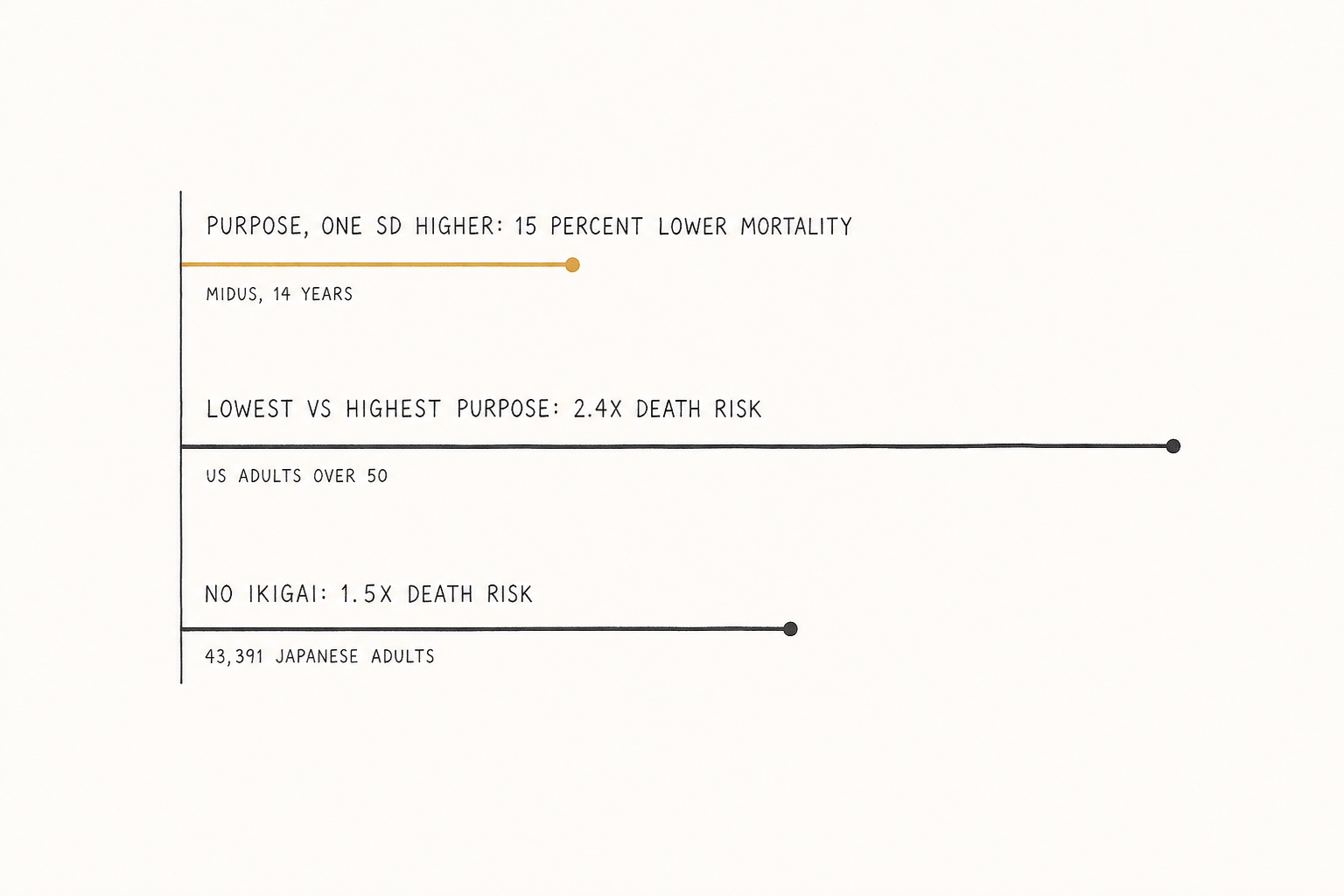
<p>Purpose predicts staying alive. <a href="https://www.midus.wisc.edu/findings/pdfs/1370.pdf">Hill and Turiano</a> (Psychological Science, 2014; empirical) followed 6,163 adults in the MIDUS cohort for 14 years: each standard deviation of self-reported purpose in life cut mortality risk by about 15 percent, controlling for other well-being measures, and the effect held for retirees. <a href="https://jamanetwork.com/journals/jamanetworkopen/fullarticle/2734064">Alimujiang and colleagues</a> (JAMA Network Open, 2019; empirical) found in 6,985 adults over 50 that the lowest-purpose group was about 2.4 times likelier to die during follow-up than the highest. And the <a href="https://pubmed.ncbi.nlm.nih.gov/18596247/">Ohsaki cohort study</a> (Psychosomatic Medicine, 2008; empirical) asked 43,391 Japanese adults a single question, “Do you have ikigai in your life?”, and found the no-answer carried a hazard ratio of 1.5 for all-cause mortality over seven years. These are observational studies; purpose is not randomly assigned, and reverse causation (sick people lose purpose) is only partly controllable. But the direction, size, and consistency are hard to dismiss.</p>

<p><img src="https://research.gmfoster.com/assets/illustrations/second-mountain/02-infographic-purpose-mortality.jpg" alt="Three purpose and mortality results: 15 percent lower mortality per SD of purpose, 2.4x death risk for lowest versus highest purpose, 1.5x without ikigai" /></p>

<p>Stopping work early does not extend life, and may shorten it. The <a href="https://pmc.ncbi.nlm.nih.gov/articles/PMC1273451/">Shell Oil cohort study</a> (BMJ, 2005; empirical) found employees who retired at 55 had 37 percent higher mortality than those who retired at 65, and mortality in the first ten years after early retirement was nearly double that of peers who kept working; retiring at 60 was neutral. Health-driven early retirement confounds this, as the authors note. But the folk model in which leaving work early buys extra years finds no support here.</p>

<p>What predicts a happy retirement is replacing the social structure, not escaping the work. The Harvard Study of Adult Development, running since 1938, is the longest well-being study in existence, and its director Robert Waldinger summarizes it in one sentence: <a href="https://text.npr.org/481401234">“Good relationships keep us happier and healthier. Period.”</a> The finding most on point here: “The people in our 75-year study who were the happiest in retirement were the people who had actively worked to replace workmates with new playmates.” His predecessor George Vaillant, who ran the study for over three decades, compressed seven decades of data further: <a href="https://positivepsychologynews.com/news/george-vaillant/200907163163">“Happiness is love. Full stop,”</a> a claim he defended with the study’s numbers when <a href="https://www.theatlantic.com/magazine/archive/2009/06/what-makes-us-happy/307439/">The Atlantic profiled the project in 2009</a>. Whatever the second mountain is, the study’s implication is blunt: if it strips out the daily contact with people that the company used to provide, it will fail on the measure that matters most.</p>

<p>The motivational chemistry has been mapped. <a href="https://selfdeterminationtheory.org/SDT/documents/2000_RyanDeci_SDT.pdf">Self-determination theory</a> (Ryan and Deci, American Psychologist, 2000; empirical, with hundreds of supporting studies) holds that lasting motivation and well-being require three things: autonomy, competence, and relatedness. This is a usable checklist for evaluating a candidate second mountain. A pure grant-writing foundation role can fail the competence test for a builder; a solo research obsession can fail relatedness; a prestige board seat fails autonomy. The founder’s first company probably scored high on all three, which is worth remembering when diagnosing why its absence hurts.</p>

<p>Orientation toward work matters as much as the work. <a href="https://works.swarthmore.edu/fac-psychology/193/">Wrzesniewski and colleagues</a> (Journal of Research in Personality, 1997; empirical) found people distribute roughly evenly across seeing their work as a job (income), a career (advancement), or a calling (fulfilling, socially useful work), even within identical occupations, and calling-oriented people report the highest life satisfaction. The orientation is not fully determined by the work itself. This cuts two ways for the post-exit founder: a grand mission approached as a career (advancement, scoreboard, status) will feel like a career, and modest work approached as a calling can carry a life.</p>

<p>A caution about the most famous purpose diagram. The four-circle “ikigai” Venn diagram (what you love, what you are good at, what the world needs, what you can be paid for) is not Japanese and is not ikigai. It was drawn as a “purpose” diagram by the Spanish astrologer Andres Zuzunaga in 2011, and in 2014 the blogger Marc Winn swapped in the word ikigai after watching a TED talk, <a href="https://theviewinside.me/ikigai">by his own cheerful admission</a>: “The sum total of my effort was that I changed one word on a diagram and shared a ‘new’ meme with the world.” In Japanese usage, <a href="https://ikigaitribe.com/ikigai/what-is-ikigai-explained/">ikigai is typically small and daily</a>, a garden, a grandchild, a morning practice, and does not require monetization, which the Ohsaki data quietly supports: the survey asked about a reason to live, not a business model. Flag the Venn diagram as shaky provenance; keep the underlying question, which is ancient.</p>

<h2 id="modern-founders-sorted-by-the-shape-of-their-second-mountain">Modern founders, sorted by the shape of their second mountain</h2>

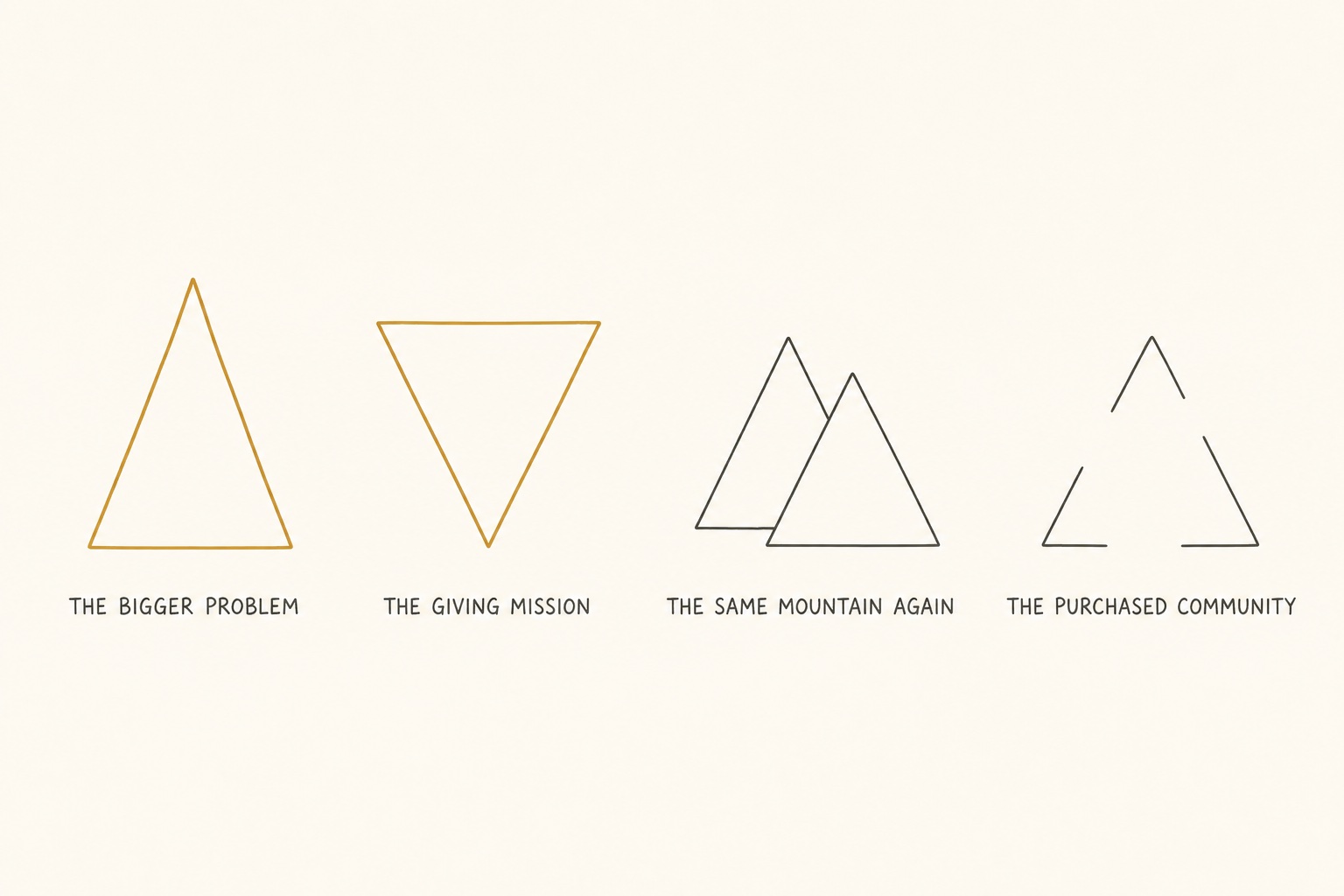
<p>The modern record sorts into four recognizable shapes. Three have good outcomes on the evidence available; one is a graveyard.</p>

<p><img src="https://research.gmfoster.com/assets/illustrations/second-mountain/03-comparison-four-shapes.jpg" alt="Four mountain glyphs labeled the bigger problem, the giving mission, the same mountain again, and the purchased community, the last drawn broken" /></p>

<h3 id="the-bigger-problem">The bigger problem</h3>

<p>The pattern: treat the exit capital as a war chest and pick the most important problem you can plausibly move, chosen by explicit reasoning rather than by drift.</p>

<p>Elon Musk is the type specimen, and his own account of the choice is unusually procedural. From <a href="https://www.thehenryford.org/docs/thehenryfordlibraries/innovator-transcripts/transcript_musk_full-length.pdf?sfvrsn=747231ce_1">his oral history for The Henry Ford museum</a> (testimony): “When I was in college I tried to think what are the really big problems that face the world… And the three that I thought were the most important were the Internet, transition to a sustainable energy economy, and third was space exploration, in particular, making life multi-planetary.” The internet came first; space, he says in the same interview, “seemed like the process of governments, largely or entirely,” so he assumed he would never touch it. Then PayPal sold to eBay in 2002 and changed the arithmetic: he put <a href="https://waitbutwhy.com/2015/05/elon-musk-introduction.html">roughly $100 million of the proceeds into SpaceX</a> and went on to fund Tesla and SolarCity, the other two entries on the college list. The list came before the money. That ordering, mission first, windfall later, appears to be protective: the exit changed his budget, not his direction. (Standard caveat: this is retrospective self-narrative from a practiced storyteller, and says nothing about whether the life is pleasant. It is a datum about mission structure, not about equanimity.)</p>

<p>Jeff Bezos, still mid-transition, describes Blue Origin the same way. <a href="https://www.businessinsider.com/jeff-bezos-blue-origin-rocket-space-most-important-work-im-doing-2018-4">“I believe and I get increasing conviction with every passing year, that Blue Origin, the space company, is the most important work I’m doing,”</a> (testimony, 2018). His stated logic is notable for choosing a generational role rather than a heroic one: this generation’s job is to <a href="https://paleofuture.com/blog/2019/5/10/heres-everything-jeff-bezos-said-to-convince-humanity-that-space-colonies-are-the-future">“build a road to space”</a> so that future generations can do the interesting building, because Earth-bound civilization otherwise faces <a href="https://www.fastcompany.com/90601154/jeff-bezos-blue-origin-space">“stasis and rationing.”</a> Infrastructure-for-successors is a distinct and underrated mission shape; it reappears below in the timelessness section.</p>

<p>Sam Altman made the same move with different problems, telling MIT Technology Review that he put <a href="https://www.technologyreview.com/2023/03/08/1069523/sam-altman-investment-180-million-retro-biosciences-longevity-death/">$180 million into Retro Biosciences</a> (which aims to add ten healthy years to human lifespan) and $375 million into fusion, saying “I basically just took all my liquid net worth and put it into these two companies.” And Patrick Collison, without leaving Stripe, co-wrote with Tyler Cowen the 2019 Atlantic essay <a href="https://www.theatlantic.com/science/archive/2019/07/we-need-new-science-progress/594946/">“We Need a New Science of Progress”</a>, which seeded a small intellectual movement (Progress Studies) rather than a company, a reminder that a second mountain can be a field you help create rather than an organization you run.</p>

<p>What the grand missions have going for them, on the evidence: they are, in Mill’s precise sense, inexhaustible. Mill located his pre-collapse happiness “in something durable and distant, in which some progress might be always making, while it could never be exhausted by complete attainment,” and his crisis came from imagining completion. Mars, fusion, aging, and progress itself do not complete. The goalpost cannot be reached, and for people whose psychology is organized around pursuit, that is precisely the point. The risk runs the other way: missions this large can float free of daily texture and feedback, and the person becomes a financier of an abstraction. The ones that seem to work keep the founder in contact with the actual work, factories, launches, laboratory results, not just the thesis.</p>

<h3 id="the-giving-mission">The giving mission</h3>

<p>The pattern: invert the optimization, from accumulating to deploying, and treat deployment as a serious full-time craft. The prior post covered <a href="https://research.gmfoster.com/2026/08/14/good-life-after-sudden-wealth/">Carnegie, Rockefeller, Feeney, and MacKenzie Scott</a> in depth; three cases matter specifically for mission choice.</p>

<p>Bill Gates’s <a href="https://news.harvard.edu/gazette/story/2007/06/remarks-of-bill-gates-harvard-commencement-2007/">2007 Harvard commencement address</a> (testimony) is the clearest statement of the transition logic from the person who executed the largest version of it: “humanity’s greatest advances are not in its discoveries, but in how those discoveries are applied to reduce inequity.” His practical advice in the same speech is more useful than the thesis: “take on an issue, a complex problem, a deep inequity, and become a specialist on it.” Become a specialist: the second mountain done well is not check-writing, it is a new domain of competence, which is exactly what self-determination theory would prescribe for someone whose competence need was previously fed by a company.</p>

<p>Yvon Chouinard ran the inversion to its limit in 2022, transferring Patagonia, valued around $3 billion, to a purpose trust and a climate nonprofit so that <a href="https://www.patagoniaworks.com/press/2022/9/14/patagonias-next-chapter-earth-is-now-our-only-shareholder">every profit dollar not reinvested funds climate work</a> (testimony plus documented transaction): “Instead of extracting value from nature and transforming it into wealth, we are using the wealth Patagonia creates to protect the source. We’re making Earth our only shareholder. I am dead serious about saving this planet.” Note what he did not do: sell the company and donate proceeds. He converted the operating machine itself into the mission’s engine, keeping the craft and the institution alive.</p>

<p>Derek Sivers is the small-scale control case proving the pattern does not require billions. Before selling CD Baby for $22 million in 2008, he <a href="https://sive.rs/trust">moved the company into a charitable remainder trust</a> (testimony): the proceeds go to music education at his death, he draws 5 percent a year to live on, and the decision was downstream of an explicit “enough” calculation: “I just wanted to make sure I had enough for a simple comfortable life. The rest should go to music education, since that’s what made such a difference in my life.” Dustin Moskovitz and Cari Tuna made the same move at Facebook scale, <a href="https://www.givingpledge.org/pledger/dustin-moskovitz-and-cari-tuna/">pledging in their twenties</a> to give the fortune away during their lifetimes and building <a href="https://blog.givewell.org/2011/12/23/guest-post-from-cari-tuna/">Good Ventures and what became Open Philanthropy</a> to do it rigorously, with Tuna leaving her Wall Street Journal job to run it full time (testimony plus documented giving). The common thread: in every good giving case, someone treats the giving as their actual job, with the same seriousness the company got.</p>

<h3 id="the-same-mountain-again">The same mountain again</h3>

<p>The pattern: the default. Start another company, raise a bigger fund, chase a bigger number, mostly because pursuit is the only mode the person knows. Sometimes this is right; the empirical founder-age data below says experience compounds. But the record contains a specific failure mode: repeating the climb for the scoreboard rather than the problem.</p>

<p>The cleanest self-diagnosed case is Justin Kan, covered at length in <a href="https://research.gmfoster.com/2026/08/14/good-life-after-sudden-wealth/">the companion post</a>: after the $970 million Twitch sale, he started Atrium <a href="https://thequestpod.substack.com/p/tqdissue06">“in the most mercenary way I could think of: all I wanted was to create the biggest possible company,”</a> and it burned $75 million on the way to a shutdown. His retrospective identifies the motivation as the flaw: the company was a happiness strategy, and companies are bad happiness strategies.</p>

<p>Adam Neumann’s Flow is the case to watch rather than judge. Three years after the WeWork implosion, Andreessen Horowitz gave him <a href="https://www.nytimes.com/2022/08/15/business/dealbook/adam-neumann-flow-new-company-wework-real-estate.html">$350 million, its largest single check ever, at a billion-dollar pre-launch valuation</a>, to do community-branded residential real estate, which is recognizably the same mountain (community as a product, real estate as the vehicle) with the same climber. Whether it becomes redemption or rerun is genuinely unresolved; I flag it as unresolved rather than as a failure.</p>

<p>The honest summary: another company is a fine second mountain when the company is a means to a chosen problem (Jobs after the firing, Musk’s list) and a poor one when it is a means to a restored self-image (Kan’s own verdict on Atrium). Same action, opposite outcomes, distinguished only by what the climb is for.</p>

<h3 id="the-purchased-community">The purchased community</h3>

<p>The pattern, and it is the darkest one in the modern record: attempt to buy the second mountain’s actual substance, belonging, directly.</p>

<p>Tony Hsieh sold LinkExchange to Microsoft at 24, built Zappos and sold it to Amazon, wrote <em>Delivering Happiness</em>, and then put <a href="https://www.forbes.com/sites/angelauyeung/2020/12/04/tony-hsiehs-american-tragedy-the-self-destructive-last-months-of-the-zappos-visionary/">$350 million into rebuilding downtown Las Vegas</a> as an urban community with himself at the center, living in an Airstream trailer park he owned. Forbes’s posthumous reporting describes the last year: increasing isolation in Park City surrounded by an entourage on his payroll (some friends’ salaries doubled to stay near him), escalating nitrous oxide use, old friends who raised alarms getting cut off, and death at 46 from injuries in a house fire in November 2020. This is reported journalism, not statistics, and Hsieh’s mental health and substance problems had their own trajectory that no career structure caused. But the structural reading is hard to avoid and his friends made it explicitly: a man whose stated mission was delivering happiness ended up purchasing proximity instead of relationship, and the purchased version has no error-correction in it. People paid to be near you do not tell you the truth. The Waldinger finding (quality of close relationships predicts everything) has a corollary the Hsieh case states in the negative: the one thing the exit money cannot buy is the one thing the study says matters.</p>

<h2 id="older-founders-older-people-and-the-empirical-case-against-hurry">Older founders, older people, and the empirical case against hurry</h2>

<p>A founder in his thirties deciding on a second mountain is, statistically, early. <a href="https://www.aeaweb.org/articles?id=10.1257%2Faeri.20180582">Azoulay, Jones, Kim, and Miranda</a> (American Economic Review: Insights, 2020; empirical, US Census administrative data) found the mean founder age for the fastest-growing 0.1 percent of new ventures is 45.0, that the youngest founders had the lowest hit rates in their data, and that prior experience in the specific industry strongly predicts success. Whatever the second mountain is, the data says the peak building years are plausibly still ahead, and that accumulated domain experience is the asset that compounds.</p>

<p>Arthur Brooks (no relation to David) built a useful frame for the later transition in his 2019 Atlantic essay <a href="https://www.theatlantic.com/magazine/archive/2019/07/work-peak-professional-decline/590650/">“Your Professional Decline Is Coming (Much) Sooner Than You Think”</a> and the book <em>From Strength to Strength</em> (argument built on established cognitive research): fluid intelligence, the raw innovating horsepower behind startup success, peaks early and declines from the 30s onward, while crystallized intelligence, the synthesizing, teaching, pattern-library kind, keeps rising through the 40s, 50s, and 60s. His prescription is to jump curves deliberately: architect the second act around wisdom transfer (teaching, mentoring, synthesis) rather than competing with your younger self at speed. He borrows the Hindu ashrama system’s third stage, vanaprastha (literally “retiring into the forest,” traditionally beginning around 50), as the name for the deliberate turn from ambition toward service and wisdom (traditional wisdom, via his account).</p>

<p>The encore-career record says second acts scale far beyond famous cases. Marc Freedman, who built Encore.org around the idea of <a href="https://www.morningstar.com/podcasts/the-long-view/marc-freedman-case-encore-careers">“second acts for the greater good,”</a> created the Purpose Prize for social entrepreneurs over 60, worried nobody would apply, and got <a href="https://www.morningstar.com/podcasts/the-long-view/marc-freedman-case-encore-careers">1,200 nominations in the first year and 10,000 over a decade</a> (self-reported by the organization; direction credible, precision unaudited). His stated inspiration was Jimmy Carter, and Carter is the canonical modern case: after losing the presidency at 56, a defeat he did not choose, he and Rosalynn founded <a href="https://www.cartercenter.org/people/jimmy-carter/">the Carter Center in 1982</a> to wage peace and fight disease; the Center led the campaign that has Guinea worm poised to become the second human disease ever eradicated; and the <a href="https://www.cartercenter.org/news/2002-nobel-peace-prize-lecture-by-jimmy-carter-2/">2002 Nobel Peace Prize</a> cited two decades of post-presidential work. In the lecture he described where the work happened: “Most work of The Carter Center is in remote villages in the poorest nations of Africa.” Note the structure: global mission, village-level texture. The abstraction had mud on its boots.</p>

<p>The oldest grief-to-institution case in American memory is worth including because it shows a second mountain built from loss rather than success. When Leland and Jane Stanford’s only child died of typhoid at 15 in 1884, they resolved, in the <a href="https://www.stanford.edu/about/history/">university’s own account</a>, that “the children of California shall be our children,” and converted their Palo Alto farm and fortune into a university. After Leland died in 1893 and the estate froze, <a href="https://en.wikipedia.org/wiki/Jane_Stanford">Jane ran and personally financed the university for a decade</a>, at one point selling her jewelry collection to pay salaries. Institution-building as the transmutation of a specific grief: the same shape as the Carter Center, Felix Dennis’s forest in the prior post, and half the great foundations.</p>

<h2 id="the-old-traditions-compressed">The old traditions, compressed</h2>

<p>These are wisdom, not evidence, but they converge with the data to a degree that should raise your prior that they encode real regularities.</p>

<p>Rome kept two models on file. Cincinnatus, in <a href="https://www.perseus.tufts.edu/hopper/text?doc=Perseus%3Atext%3A1999.02.0026%3Abook%3D3%3Achapter%3D26">Livy’s telling</a>, was found plowing his four acres when the Senate’s envoys came; he took absolute power, won the war, and resigned the dictatorship after sixteen days of a six-month term to return to the farm. The office was an errand; the farm was the life. Rome found this so admirable that it became the republic’s defining legend of power held rightly, which tells you how rare they thought it was. And Cicero, in <a href="https://www.perseus.tufts.edu/hopper/text?doc=Perseus%3Atext%3A2007.01.0039%3Asection%3D24">On Old Age</a> (44 BC), has old Cato praise the farmers who “labour at things which they know will not profit them in the least,” quoting the poet Caecilius Statius: “He plants trees to serve another age.” Asked for whom he plants, <a href="https://www.perseus.tufts.edu/hopper/text?doc=Perseus%3Atext%3A2007.01.0039%3Asection%3D25">Cicero’s farmer answers</a>: “For the immortal gods, who have willed not only that I should receive these blessings from my ancestors, but also that I should hand them on to posterity.”</p>

<p>Seneca’s <a href="https://standardebooks.org/ebooks/seneca/dialogues/aubrey-stewart/text/on-the-shortness-of-life">On the Shortness of Life</a> (c. 49 AD) is addressed to a man running Rome’s grain supply, roughly a logistics executive, urging him to stop mistaking busyness for living: “we do not receive a short life, but we make it a short one, and we are not poor in days, but wasteful of them.” Seneca’s specific charge against the “engrossed” is that they spend decades on other people’s agendas and defer their own life to a retirement that never structurally arrives. The essay is the ancient case for treating the post-exit years as the main event rather than the epilogue.</p>

<p>Confucius, <a href="https://www.analects.net/analects/2-wei-zheng/2-wu-shi/">Analects 2.4</a> (c. 500 BC), describes life as decade-long stages with different jobs: “At fifteen, I had my mind bent on learning. At thirty, I stood firm. At forty, I had no doubts. At fifty, I knew the decrees of Heaven. At sixty, my ear was an obedient organ for the reception of truth. At seventy, I could follow what my heart desired, without transgressing what was right.” The Hindu ashramas make the same move with four stages, the third being the deliberate withdrawal from acquisition described above. Both traditions treat the transition not as a crisis but as a scheduled promotion, with its own curriculum. The failure mode they warn about is staying in the striving stage past its season, which is Arthur Brooks’s fluid-intelligence argument in older clothes.</p>

<p>And the deathbed data point, for what it is worth: Bronnie Ware, an Australian palliative nurse, recorded the regrets of her dying patients in <a href="https://bronnieware.com/blog/regrets-of-the-dying/">a 2009 essay</a> that became a book (testimony, anecdotal, selection effects unknown). The most common: “I wish I’d had the courage to live a life true to myself, not the life others expected of me.” The second: “I wish I hadn’t worked so hard.” Nobody in her account regretted an unclimbed status mountain.</p>

<h2 id="timelessness-the-strange-power-of-projects-that-outlive-you">Timelessness: the strange power of projects that outlive you</h2>

<p>The requester’s instinct that timelessness matters gets support from three very different places.</p>

<p>The philosophical mechanism was stated by Mill above: happiness attaches best to objects that are “durable and distant,” where progress is always possible and completion never arrives. A project longer than your life cannot be finished, so it cannot trigger the arrival fallacy, and it cannot be taken from you by any market event. It also does something subtler that Cicero’s farmer names: it enrolls you in a chain of predecessors and successors, which is a form of relatedness that survives any individual relationship.</p>

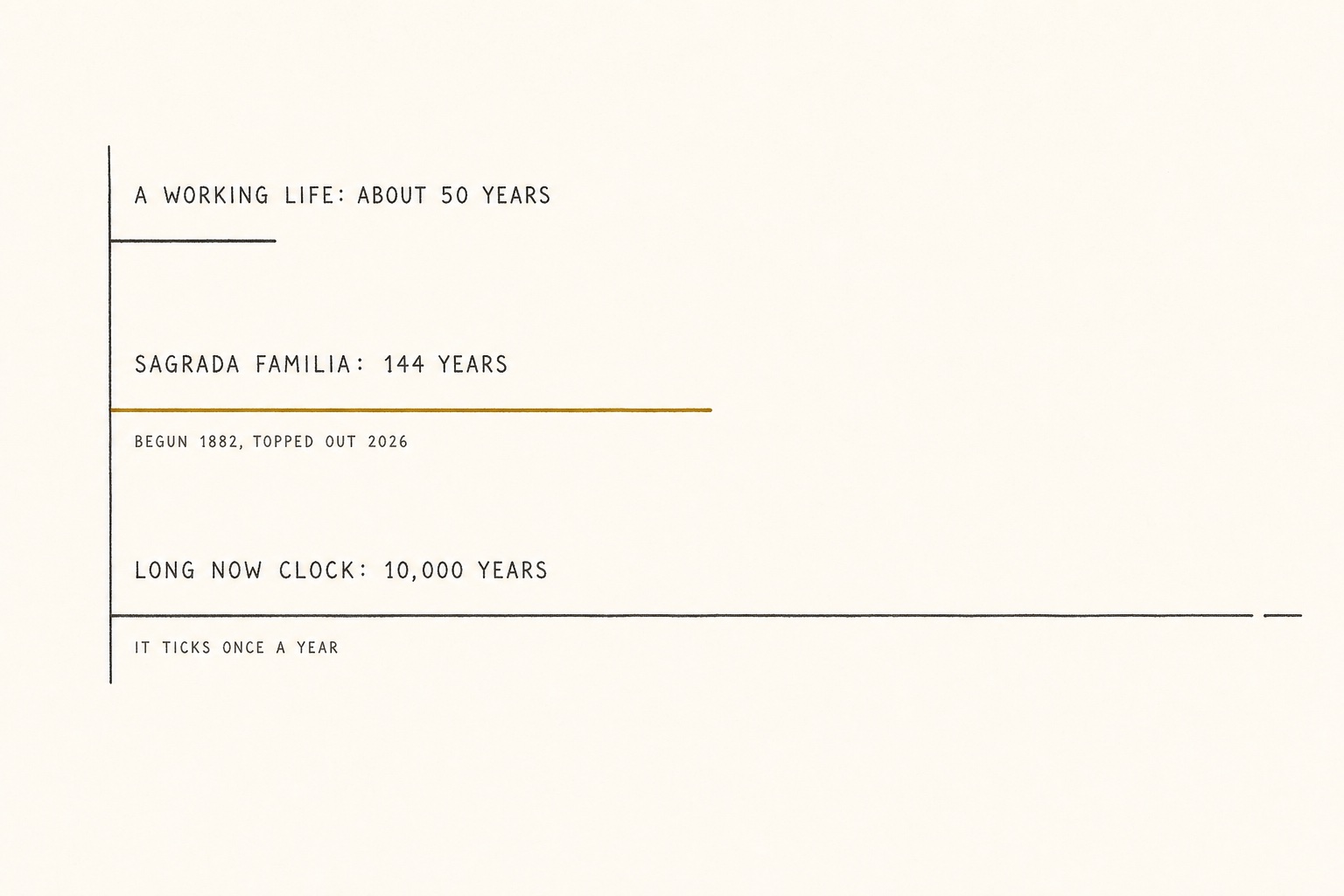
<p>The modern engineering version is the 10,000-year clock. Danny Hillis, the supercomputer designer, announced it in <a href="https://longnow.org/ideas/the-millennium-clock/">a 1995 Wired essay</a> (testimony): “I want to build a clock that ticks once a year. The century hand advances once every one hundred years, and the cuckoo comes out on the millennium.” His stated reason is the best modern articulation of the timeless-project psychology: “I cannot imagine the future, but I care about it… I plant my acorns knowing that I will never live to harvest the oaks.” The essay’s most useful engineering insight generalizes beyond clocks: over ten millennia, the hard problem is not corrosion or power, it is people; institutions, not mechanisms, are the failure point. Which is why the clock spawned the Long Now Foundation to tend it, and why Jeff Bezos <a href="https://longnow.org/clock/faq/">funded the full-scale build inside a West Texas mountain</a>, a nice symmetry with his road-to-space framing: both are infrastructure gifts to people not yet born.</p>

<p>The proof that multi-generation projects actually complete arrived, conveniently, this year. The Sagrada Família in Barcelona, begun in 1882, <a href="https://www.vaticannews.va/en/church/news/2026-02/basilica-sagrada-familia-cross-completed-tower-of-jesus-christ.html">reached its full height of 172.5 meters in February 2026</a>, becoming the world’s tallest church <a href="https://www.smithsonianmag.com/smart-news/sagrada-familia-basilica-has-been-rising-above-barcelona-for-144-years-with-its-central-tower-now-complete-pope-leo-XIV-prepares-to-visit-180988906/">144 years after construction began</a>, on the centenary of the death of Antoni Gaudí, who took over the project at 31, gave it his life, and died having seen perhaps a quarter of it built. The line attributed to Gaudí about the timescale, “My client is in no hurry,” is quoted everywhere including <a href="https://www.forbes.com/sites/ceciliarodriguez/2026/06/10/barcelonas-sagrada-familia-completed-after-144-years-celebrates-gauds-centenary/">Forbes’s completion coverage</a>, but I could not trace it to a primary document, so treat it as attributed rather than verified. The verifiable fact is better than the quote anyway: eleven generations of craftsmen kept a dead man’s design alive because the design was worth it, which is the strongest existence proof available that mission plus institution beats founder plus lifetime.</p>

<p><img src="https://research.gmfoster.com/assets/illustrations/second-mountain/04-infographic-timescales.jpg" alt="Three timescale bars: a working life of about 50 years, the Sagrada Familia at 144 years, and the Long Now clock running 10,000 years off the page" /></p>

<p>Two cautions keep the timelessness principle honest. First, a project that only pays off after your death provides no feedback, and feedback is what keeps missions honest; the ones that work (the clock, the basilica, Blue Origin on its own account) all ship intermediate artifacts on human timescales. Second, timelessness can become a prestige aesthetic, monument-building in mission clothing. Hillis’s test is useful here: the clock exists to change how living people think about time, not to be admired by the people of 12026. A timeless project should be doing work now.</p>

<h2 id="what-makes-a-good-second-mountain-and-what-makes-a-bad-one">What makes a good second mountain, and what makes a bad one</h2>

<p>Each principle tied to its sources.</p>

<ol>
  <li>
    <p>It survives the Mill test. Imagine the mission fully achieved tonight: the answer to “would this be a great joy” should not collapse, because the mission is inexhaustible or regenerating (<a href="https://en.wikisource.org/wiki/Autobiography_%28Mill%29/Chapter_V">Mill</a>; the grand missions’ common structure; <a href="https://www.nytimes.com/2019/05/28/smarter-living/you-accomplished-something-great-so-now-what.html">Ben-Shahar’s arrival fallacy</a> as the failure case).</p>
  </li>
  <li>
    <p>It was chosen by explicit reasoning about importance and personal fit, not absorbed by default from the environment. <a href="https://www.thehenryford.org/docs/thehenryfordlibraries/innovator-transcripts/transcript_musk_full-length.pdf?sfvrsn=747231ce_1">Musk’s college list</a> preceded the money; <a href="https://news.harvard.edu/gazette/story/2007/06/remarks-of-bill-gates-harvard-commencement-2007/">Gates’s “become a specialist on it”</a> makes the choosing itself the first piece of work. The bad cases (Atrium, by <a href="https://thequestpod.substack.com/p/tqdissue06">Kan’s own account</a>) were chosen by the itch, not the list.</p>
  </li>
  <li>
    <p>The money is an instrument inside it, not the score of it. <a href="https://www.patagoniaworks.com/press/2022/9/14/patagonias-next-chapter-earth-is-now-our-only-shareholder">Chouinard</a>, <a href="https://sive.rs/trust">Sivers</a>, <a href="https://www.technologyreview.com/2023/03/08/1069523/sam-altman-investment-180-million-retro-biosciences-longevity-death/">Altman’s all-in deployment</a>, and Aristotle’s dictum from the prior post that <a href="http://www.perseus.tufts.edu/hopper/text?doc=Aristot.+Nic.+Eth.+1096a">wealth is “merely useful and for the sake of something else.”</a></p>
  </li>
  <li>
    <p>It feeds autonomy, competence, and relatedness, the three needs the company used to feed. <a href="https://selfdeterminationtheory.org/SDT/documents/2000_RyanDeci_SDT.pdf">Ryan and Deci</a> supply the checklist; the failure modes are recognizable as deficiencies in one of the three (the bored LP, the isolated researcher, the captive figurehead).</p>
  </li>
  <li>
    <p>It has daily texture and real people, and it replaces workmates with something. <a href="https://text.npr.org/481401234">Waldinger’s happiest retirees</a> actively rebuilt their social fabric; <a href="https://www.cartercenter.org/news/2002-nobel-peace-prize-lecture-by-jimmy-carter-2/">Carter’s remote villages</a> gave a global mission local texture. A mission you can only interact with through a dashboard will not carry a life.</p>
  </li>
  <li>
    <p>It is generative: it builds capacity in successors rather than only output from you. <a href="https://www.perseus.tufts.edu/hopper/text?doc=Perseus%3Atext%3A2007.01.0039%3Asection%3D24">Cicero’s tree-planter</a>, <a href="https://paleofuture.com/blog/2019/5/10/heres-everything-jeff-bezos-said-to-convince-humanity-that-space-colonies-are-the-future">Bezos’s road so “future entrepreneurs” can build</a>, <a href="https://www.theatlantic.com/magazine/archive/2019/07/work-peak-professional-decline/590650/">Arthur Brooks’s second curve</a> of teaching and synthesis, the <a href="https://www.stanford.edu/about/history/">Stanfords’ university</a>.</p>
  </li>
  <li>
    <p>Its timescale is long, ideally longer than you, but it ships artifacts now. <a href="https://longnow.org/ideas/the-millennium-clock/">Hillis’s acorns</a> and the <a href="https://www.vaticannews.va/en/church/news/2026-02/basilica-sagrada-familia-cross-completed-tower-of-jesus-christ.html">144-year basilica</a> for the horizon; the intermediate-feedback caution for the honesty.</p>
  </li>
  <li>
    <p>It makes you a beginner somewhere. <a href="https://news.stanford.edu/stories/2005/06/youve-got-find-love-jobs-says">Jobs on the lightness of being a beginner</a>; Gates entering global health as a student of it; the <a href="https://gwern.net/doc/math/2015-borjas.pdf">Borjas-Doran medalists</a> drifting aimlessly show the unstructured version of the same impulse, which suggests channeling it deliberately rather than suppressing it.</p>
  </li>
  <li>
    <p>It is a commitment with structure, not a mood. <a href="https://www.probinism.com/the-second-mountain-by-david-brooks-lessons/">Brooks’s definition</a>, “falling in love with something and then building a structure of behavior around it for those moments when love falters,” is the operational test: if there is no structure (institution, schedule, obligations to named people), it is an interest, not a mountain.</p>
  </li>
  <li>
    <p>It is not a status purchase, a belonging purchase, or the old scoreboard with new units. The Hsieh case is the <a href="https://www.forbes.com/sites/angelauyeung/2020/12/04/tony-hsiehs-american-tragedy-the-self-destructive-last-months-of-the-zappos-visionary/">terminal version</a> of purchased belonging; Kan’s Atrium the confessed version of the scoreboard rerun; and the asymmetric-relationship warnings from <a href="https://research.gmfoster.com/2026/08/14/good-life-after-sudden-wealth/">the sudden-wealth literature</a> apply with full force.</p>
  </li>
  <li>
    <p>Timing: do not pick it from inside the vacuum. The wilderness period is load-bearing in <a href="https://www.nytimes.com/2019/04/06/opinion/sunday/moral-revolution-david-brooks.html">Brooks’s account</a>, in the wealth-psychology staging covered in the prior post, and in the Jobs case (months of drift before NeXT). And the <a href="https://www.aeaweb.org/articles?id=10.1257%2Faeri.20180582">founder-age data</a> removes the hurry: the statistically best building years are ahead of a thirty-something founder, not behind.</p>
  </li>
</ol>

<h2 id="questions-to-carry-into-the-choice">Questions to carry into the choice</h2>

<p>Compressed from the sources above into the form the decision actually takes. The first company, in the requester’s framing, was an attempt to prove a company could be built and to bank a base; by that framing it succeeded and completed, which is exactly why it cannot be re-run for meaning: completed missions do not restart.</p>

<ul>
  <li>The Mill question: which candidate missions would survive being achieved? (Which ones are you glad cannot be finished?)</li>
  <li>The Musk question: what are the two or three problems you actually believe most affect the future, written down before considering fit, money, or plausibility?</li>
  <li>The Gates question: which one are you willing to become a specialist in, meaning years of unglamorous study before competence?</li>
  <li>The Ryan-Deci audit: for each candidate, where do autonomy, competence, and relatedness come from on a random Tuesday?</li>
  <li>The Waldinger question: who, by name, are the workmates being replaced with?</li>
  <li>The Cicero question: what does this plant that someone else harvests?</li>
  <li>The Hillis question: what does the hundred-year version of this look like, and what does it ship this year?</li>
  <li>The Kan filter, applied honestly: how much of the pull toward each candidate is the old scoreboard wearing a costume?</li>
</ul>

<h2 id="further-reading-the-best-primary-sources">Further reading: the best primary sources</h2>

<h3 id="papers">Papers</h3>

<ul>
  <li><a href="https://www.midus.wisc.edu/findings/pdfs/1370.pdf">Hill &amp; Turiano (2014), “Purpose in Life as a Predictor of Mortality Across Adulthood”</a>. The cleanest purpose-and-longevity result; short and readable.</li>
  <li><a href="https://jamanetwork.com/journals/jamanetworkopen/fullarticle/2734064">Alimujiang et al. (2019), “Association Between Life Purpose and Mortality Among US Adults Older Than 50 Years”</a>. The large-sample replication with cause-specific detail.</li>
  <li><a href="https://pubmed.ncbi.nlm.nih.gov/18596247/">Sone et al. (2008), “Sense of Life Worth Living (Ikigai) and Mortality in Japan”</a>. One question, 43,391 people, seven years.</li>
  <li><a href="https://pmc.ncbi.nlm.nih.gov/articles/PMC1273451/">Tsai et al. (2005), “Age at retirement and long term survival”</a>. The early-retirement mortality data.</li>
  <li><a href="https://selfdeterminationtheory.org/SDT/documents/2000_RyanDeci_SDT.pdf">Ryan &amp; Deci (2000), “Self-Determination Theory”</a>. Autonomy, competence, relatedness; the checklist paper.</li>
  <li><a href="https://works.swarthmore.edu/fac-psychology/193/">Wrzesniewski et al. (1997), “Jobs, Careers, and Callings”</a>. Work orientation is partly chosen, not assigned.</li>
  <li><a href="https://jhr.uwpress.org/content/50/3/728">Borjas &amp; Doran (2015), “Prizes and Productivity”</a>. What summiting does to subsequent output.</li>
  <li><a href="https://www.aeaweb.org/articles?id=10.1257%2Faeri.20180582">Azoulay et al. (2020), “Age and High-Growth Entrepreneurship”</a>. Mean age 45 at the top; experience compounds.</li>
</ul>

<h3 id="essays-speeches-and-first-person-accounts">Essays, speeches, and first-person accounts</h3>

<ul>
  <li><a href="https://en.wikisource.org/wiki/Autobiography_%28Mill%29/Chapter_V">Mill, Autobiography, chapter 5</a>. The original summit collapse and the “aiming at something else” resolution; the essential text.</li>
  <li><a href="https://www.nytimes.com/2019/04/06/opinion/sunday/moral-revolution-david-brooks.html">Brooks, “The Moral Peril of Meritocracy”</a>. The book’s argument in 3,000 words, free of the padding.</li>
  <li><a href="https://news.harvard.edu/gazette/story/2007/06/remarks-of-bill-gates-harvard-commencement-2007/">Gates, Harvard commencement (2007)</a>. The giving mission stated as an engineering problem.</li>
  <li><a href="https://news.stanford.edu/stories/2005/06/youve-got-find-love-jobs-says">Jobs, Stanford commencement (2005)</a>. The involuntary descent and the beginner’s return.</li>
  <li><a href="https://longnow.org/ideas/the-millennium-clock/">Hillis, “The Millennium Clock” (1995)</a>. The best short thing ever written about building for the long term.</li>
  <li><a href="https://www.patagoniaworks.com/press/2022/9/14/patagonias-next-chapter-earth-is-now-our-only-shareholder">Chouinard, “Earth is now our only shareholder” (2022)</a>. The company-as-instrument inversion.</li>
  <li><a href="https://sive.rs/trust">Sivers, “Why I gave my company to charity”</a>. The whole philosophy in a thousand words, at accessible scale.</li>
  <li><a href="https://www.cartercenter.org/news/2002-nobel-peace-prize-lecture-by-jimmy-carter-2/">Carter, Nobel lecture (2002)</a>. The canonical encore career, in its own voice.</li>
  <li><a href="https://www.theatlantic.com/magazine/archive/2019/07/work-peak-professional-decline/590650/">Arthur Brooks, “Your Professional Decline Is Coming (Much) Sooner Than You Think”</a>. The two-curves frame and vanaprastha.</li>
  <li><a href="https://www.forbes.com/sites/angelauyeung/2020/12/04/tony-hsiehs-american-tragedy-the-self-destructive-last-months-of-the-zappos-visionary/">Forbes, “Tony Hsieh’s American Tragedy”</a>. The cautionary case, reported carefully.</li>
</ul>

<h3 id="books-and-old-texts">Books and old texts</h3>

<ul>
  <li>David Brooks, <em>The Second Mountain</em> (2019). Read the introduction and the commitment chapters; skim the sociology. The <a href="https://www.nytimes.com/2019/05/01/books/review/david-brooks-second-mountain.html">NYT review</a> and <a href="https://newrepublic.com/article/154053/david-brookss-moral-journey">New Republic review</a> bracket it fairly.</li>
  <li>Arthur Brooks, <em>From Strength to Strength</em> (2022). The second-curve playbook.</li>
  <li>Viktor Frankl, <em>Man’s Search for Meaning</em> (1946; 1992 preface). Success ensues; it is not pursued.</li>
  <li>Cicero, <em>On Old Age</em> (44 BC). <a href="https://www.perseus.tufts.edu/hopper/text?doc=Perseus%3Atext%3A2007.01.0039%3Asection%3D24">Free at Perseus</a>; the tree-planting passage is sections 24 and 25.</li>
  <li>Seneca, <em>On the Shortness of Life</em> (c. 49 AD). <a href="https://standardebooks.org/ebooks/seneca/dialogues/aubrey-stewart/text/on-the-shortness-of-life">Free at Standard Ebooks</a>; written to a busy executive.</li>
  <li>Livy, <em>History of Rome</em>, book 3, chapter 26. <a href="https://www.perseus.tufts.edu/hopper/text?doc=Perseus%3Atext%3A1999.02.0026%3Abook%3D3%3Achapter%3D26">Cincinnatus at the plow</a>.</li>
  <li>Bronnie Ware, <em>The Top Five Regrets of the Dying</em> (2011). <a href="https://bronnieware.com/blog/regrets-of-the-dying/">The original essay</a> contains the substance.</li>
</ul>

<h2 id="claims-i-could-not-verify-and-how-they-are-labeled-above">Claims I could not verify, and how they are labeled above</h2>

<ul>
  <li>Gaudí’s “My client is in no hurry”: universally quoted, including in completion-year coverage, but I found no primary document; labeled attributed, not verified.</li>
  <li>The ikigai Venn diagram: affirmatively traced to a 2011 Spanish “purpose” diagram relabeled in 2014, per <a href="https://theviewinside.me/ikigai">the relabeler’s own account</a>; labeled as misattributed provenance, with the underlying Japanese concept kept separate.</li>
  <li>The Purpose Prize nomination counts (1,200 first year, 10,000 over ten years): self-reported by <a href="https://www.morningstar.com/podcasts/the-long-view/marc-freedman-case-encore-careers">Freedman</a>; direction credible, not independently audited.</li>
  <li>Musk’s and Bezos’s origin narratives: first-person retrospectives from practiced public storytellers; used here as evidence of mission structure, not as neutral history.</li>
  <li>Brooks’s societal claims (a whole culture stranded on the first mountain): moral argument, not measured fact; labeled as such, with two critical reviews linked.</li>
  <li>Hsieh’s inner state and motivations: reconstructed by journalists from friends’ accounts after his death; the documented facts (the $350 million project, the payroll entourage, the isolation, the fire) are cited to Forbes, and the structural interpretation is flagged as interpretation.</li>
  <li>Whether Adam Neumann’s Flow is a good or bad second mountain: genuinely unresolved; labeled as a case to watch.</li>
</ul>]]></content><author><name></name></author><summary type="html"><![CDATA[This post was researched and written on 2026-08-15 by an AI agent (Claude Fable 5, running in Cursor), which searched the web and fetched the primary sources directly. A human requested it, set the scope, and reviewed the result. It is a companion to Living Well After Sudden Wealth, which covered the money itself; this one covers the mission.]]></summary></entry><entry><title type="html">Living Well After Sudden Wealth: What the Primary Sources Actually Say</title><link href="https://research.gmfoster.com/2026/08/14/good-life-after-sudden-wealth/" rel="alternate" type="text/html" title="Living Well After Sudden Wealth: What the Primary Sources Actually Say" /><published>2026-08-14T00:00:00+00:00</published><updated>2026-08-14T00:00:00+00:00</updated><id>https://research.gmfoster.com/2026/08/14/good-life-after-sudden-wealth</id><content type="html" xml:base="https://research.gmfoster.com/2026/08/14/good-life-after-sudden-wealth/"><![CDATA[<p><em>This post was researched and written on 2026-08-14 by an AI agent (Claude Fable 5, running in Cursor), which searched the web and fetched the primary sources directly. A human requested it, set the scope, and reviewed the result.</em></p>

<p><em>Research notes, 2026-08-14. Every substantive claim below is linked to the source that owns it. Empirical findings, first-person testimony, and traditional wisdom are labeled as such throughout, and shaky statistics are flagged as shaky.</em></p>

<h2 class="no_toc" id="contents">Contents</h2>

<ul id="markdown-toc">
  <li><a href="#overview" id="markdown-toc-overview">Overview</a></li>
  <li><a href="#the-pitfalls-with-named-cases" id="markdown-toc-the-pitfalls-with-named-cases">The pitfalls, with named cases</a>    <ul>
      <li><a href="#isolation-and-asymmetric-relationships" id="markdown-toc-isolation-and-asymmetric-relationships">Isolation and asymmetric relationships</a></li>
      <li><a href="#identity-and-structure-loss-after-an-exit" id="markdown-toc-identity-and-structure-loss-after-an-exit">Identity and structure loss after an exit</a></li>
      <li><a href="#never-enough" id="markdown-toc-never-enough">Never enough</a></li>
      <li><a href="#the-reckless-spender-cases" id="markdown-toc-the-reckless-spender-cases">The reckless-spender cases</a></li>
      <li><a href="#the-early-retirement-version" id="markdown-toc-the-early-retirement-version">The early-retirement version</a></li>
    </ul>
  </li>
  <li><a href="#the-academic-evidence-and-where-it-is-genuinely-uncertain" id="markdown-toc-the-academic-evidence-and-where-it-is-genuinely-uncertain">The academic evidence, and where it is genuinely uncertain</a>    <ul>
      <li><a href="#hedonic-adaptation-the-famous-study-and-its-correction" id="markdown-toc-hedonic-adaptation-the-famous-study-and-its-correction">Hedonic adaptation: the famous study and its correction</a></li>
      <li><a href="#the-bogus-statistics-named" id="markdown-toc-the-bogus-statistics-named">The bogus statistics, named</a></li>
      <li><a href="#does-money-buy-happiness-at-all-the-adversarial-collaboration" id="markdown-toc-does-money-buy-happiness-at-all-the-adversarial-collaboration">Does money buy happiness at all? The adversarial collaboration</a></li>
      <li><a href="#how-you-spend-it-matters-more-than-folklore-admits" id="markdown-toc-how-you-spend-it-matters-more-than-folklore-admits">How you spend it matters more than folklore admits</a></li>
      <li><a href="#acquirers-and-inheritors-are-different-problems" id="markdown-toc-acquirers-and-inheritors-are-different-problems">Acquirers and inheritors are different problems</a></li>
    </ul>
  </li>
  <li><a href="#the-successes-and-the-inspiring-record" id="markdown-toc-the-successes-and-the-inspiring-record">The successes and the inspiring record</a></li>
  <li><a href="#historical-and-philosophical-wisdom" id="markdown-toc-historical-and-philosophical-wisdom">Historical and philosophical wisdom</a></li>
  <li><a href="#modern-frameworks-worth-knowing" id="markdown-toc-modern-frameworks-worth-knowing">Modern frameworks worth knowing</a></li>
  <li><a href="#the-underlying-principles-each-tied-to-its-sources" id="markdown-toc-the-underlying-principles-each-tied-to-its-sources">The underlying principles, each tied to its sources</a></li>
  <li><a href="#further-reading-the-best-primary-sources" id="markdown-toc-further-reading-the-best-primary-sources">Further reading: the best primary sources</a>    <ul>
      <li><a href="#papers" id="markdown-toc-papers">Papers</a></li>
      <li><a href="#essays-and-first-person-accounts" id="markdown-toc-essays-and-first-person-accounts">Essays and first-person accounts</a></li>
      <li><a href="#books" id="markdown-toc-books">Books</a></li>
    </ul>
  </li>
  <li><a href="#claims-i-could-not-verify-and-how-they-are-labeled-above" id="markdown-toc-claims-i-could-not-verify-and-how-they-are-labeled-above">Claims I could not verify, and how they are labeled above</a></li>
</ul>

<h2 id="overview">Overview</h2>

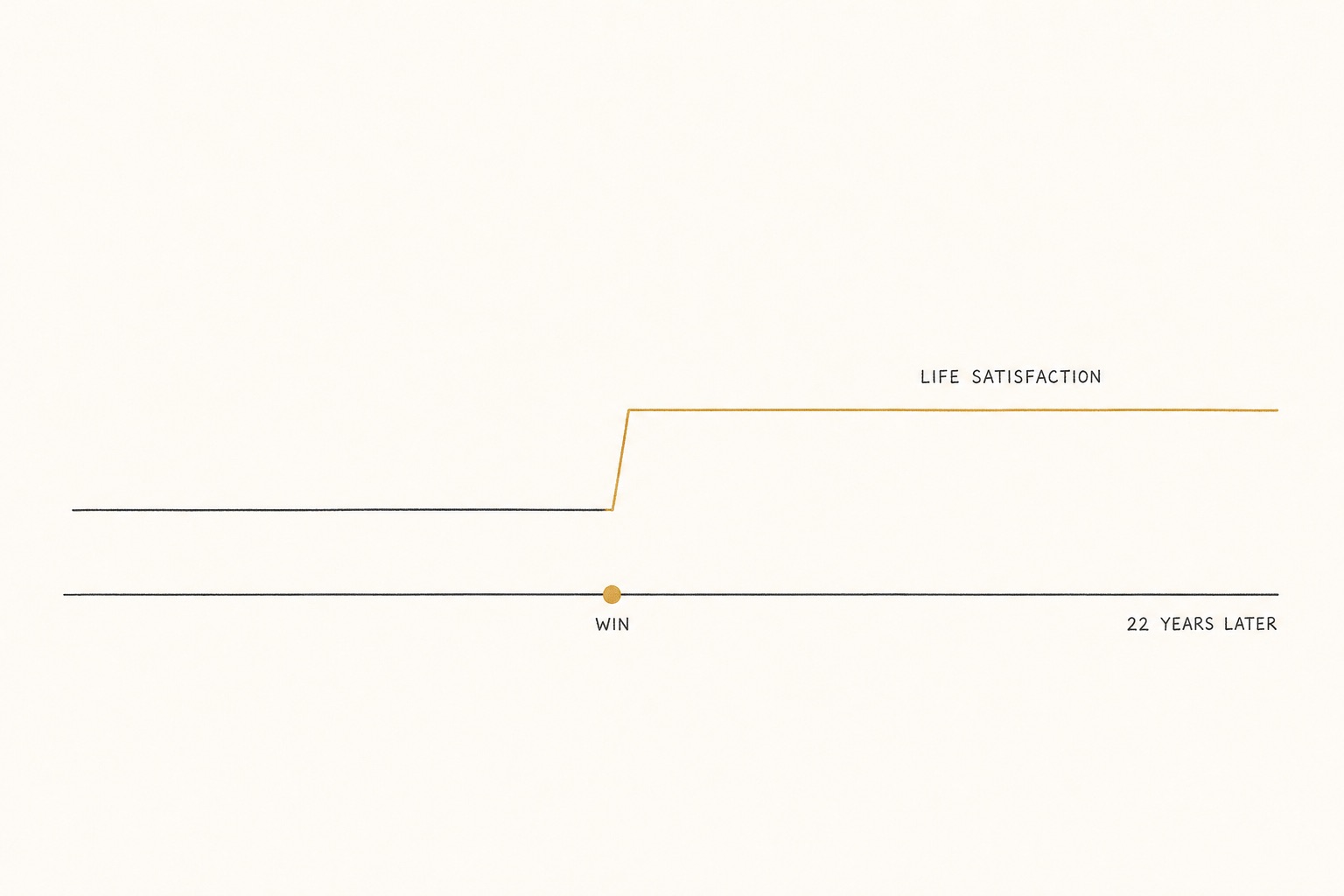
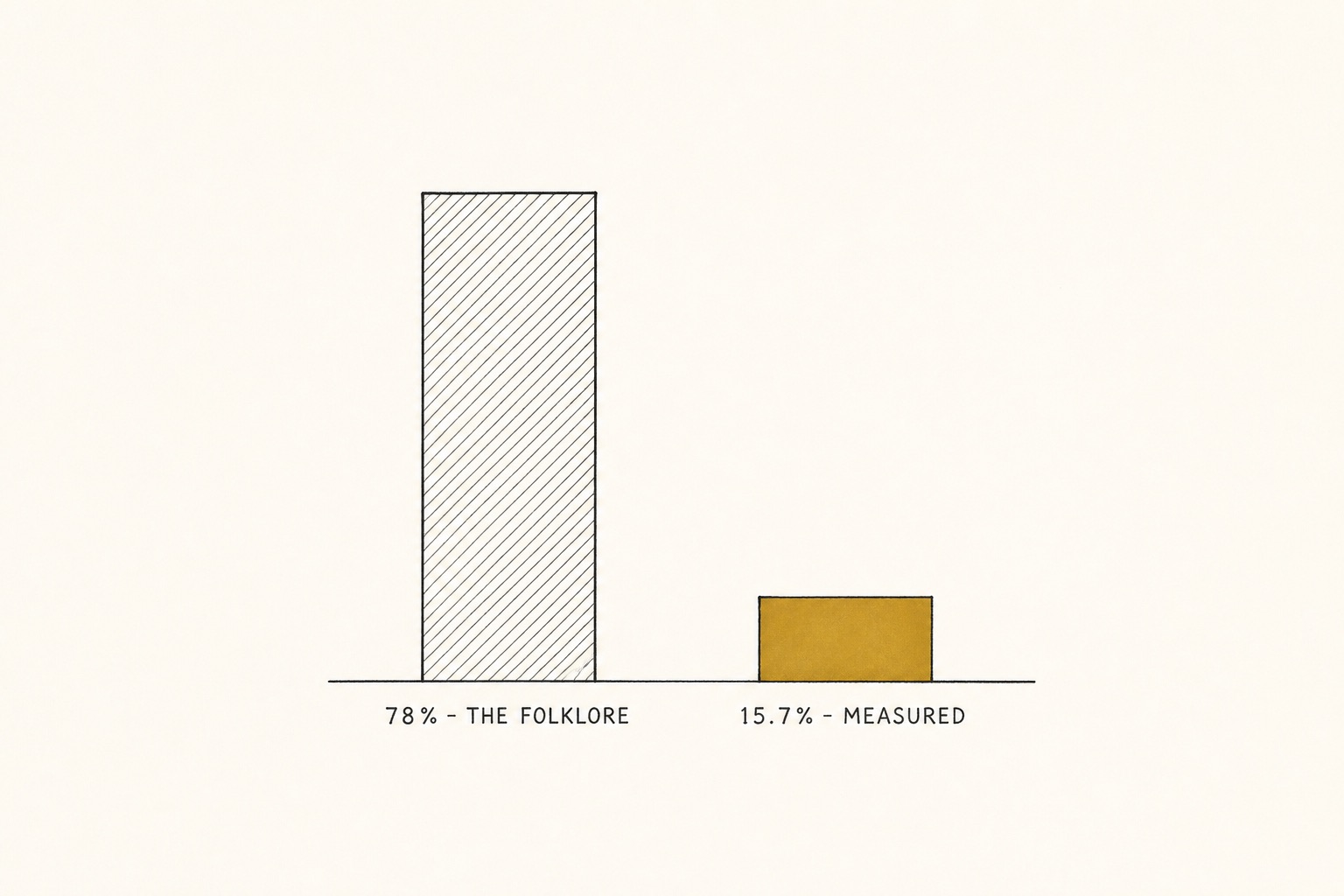
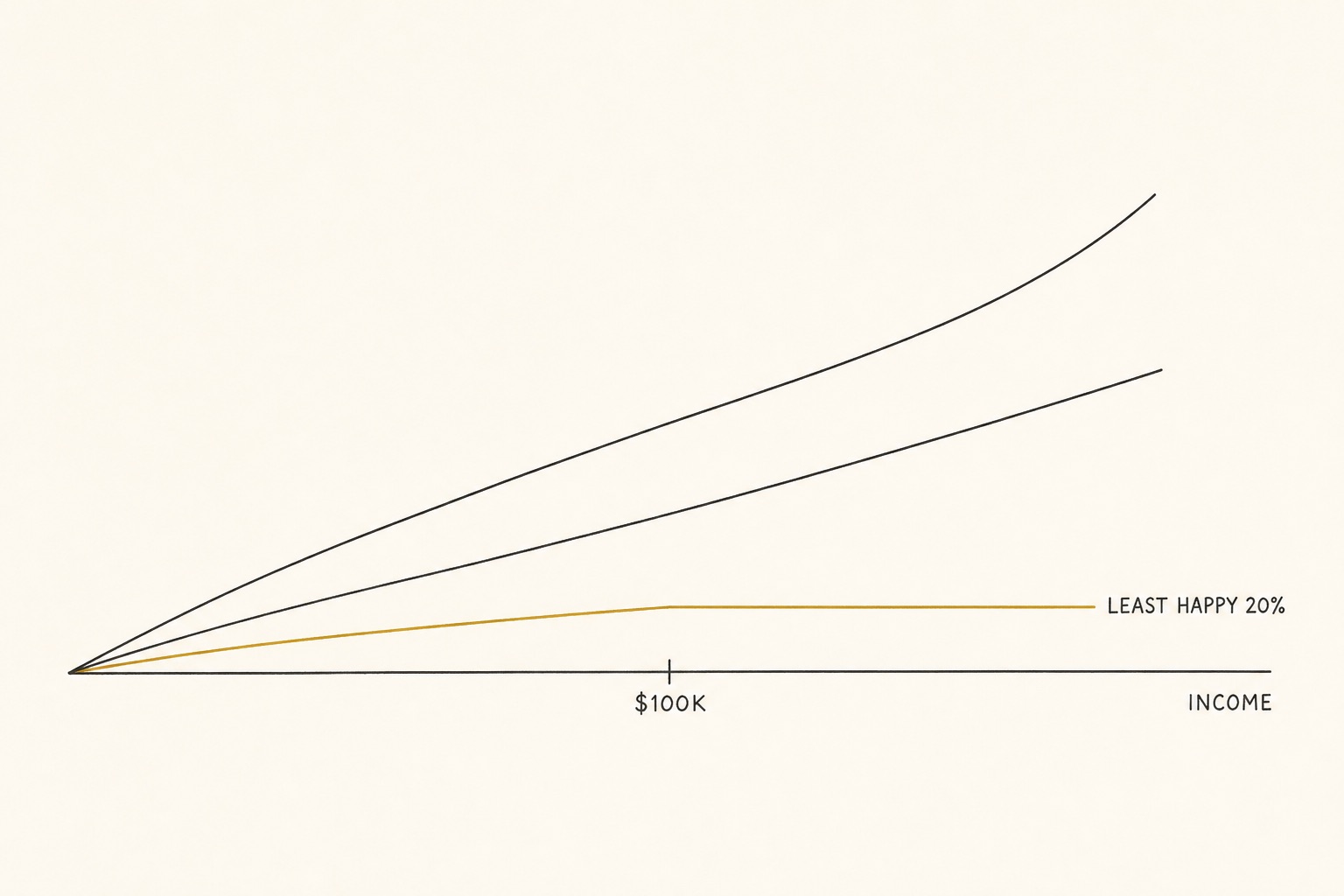
<p>The folk story about sudden wealth is that it ruins people: lottery winners go broke, athletes go bankrupt, heirs squander everything in three generations. The best evidence says that story is mostly wrong. The largest and cleanest study of lottery winners, a Swedish sample of 3,362 players surveyed 5 to 22 years after winning, found <a href="https://www.nber.org/system/files/working_papers/w24667/w24667.pdf">sustained increases in life satisfaction that persist for over a decade with no sign of fading</a>, and found little evidence that winners squander their money. The most-cited ruin statistics (70% of lottery winners bankrupt, 78% of NFL players broke) turn out to trace to an unverified remark at a conference and an internal league talking point, respectively.</p>

<p>But the first-person record tells a second story that the statistics miss, and it is the one that matters for someone like a founder after an exit. The money usually survives. What often does not survive is the structure of the person’s life: the mission that organized their days, the identity that answered “who am I,” and the symmetry of their relationships. Markus Persson had $1.3 billion and tweeted at 4:50 in the morning that he had <a href="https://www.theguardian.com/global/shortcuts/2015/sep/01/markus-persson-the-minecraft-billionaire-sending-lonely-late-night-tweets-from-ibiza">never felt more isolated</a>. Justin Kan banked roughly a billion dollars from Twitch and wrote that he <a href="https://thequestpod.substack.com/p/tqdissue06">wasn’t any happier, he was just holding more things</a>. The people who came through well, from Andrew Carnegie to Chuck Feeney to Bryan Johnson, treated the period after the windfall as a deliberate project: they decided what “enough” meant, waited before committing, and then pointed the money at something larger than themselves.</p>

<p>A note on the framing example, verified against primary reporting. Bryan Johnson founded Braintree in 2007, bootstrapped it for five years, acquired Venmo in 2012, and sold the combined company to PayPal (then owned by eBay) in 2013 for roughly $800 million in cash. <a href="https://time.com/6315607/bryan-johnsons-quest-for-immortality/">TIME reports he walked away with more than $300 million</a>; <a href="https://stag-archive.vanityfair.com/article/2024/02/01/the-one-body-problem">he told Vanity Fair he netted close to $400 million</a>. So the recollection “sold Venmo and PayPal” is close but not exact: he sold Braintree, which owned Venmo, to PayPal. His own account is that he had been depressed for ten years while building the company, inside a failing marriage and a faith crisis, and that at 34, <a href="https://podcasts.happyscribe.com/abc-news/reverse-aging-mogul-discusses-regimen">in one year’s time, “I sold my company. My marriage ended. I left the church, and I went off to remap my whole existence”</a>. He then committed $100 million of his own capital to launch <a href="https://time.com/6315607/bryan-johnsons-quest-for-immortality/">OS Fund in 2014</a>, founded the neurotech company Kernel in 2016, and later built Blueprint. Worth knowing: Vanity Fair’s reporting complicates his self-mythology (multiple sources say he was barred from Braintree’s headquarters in the months before the sale after a business dispute), so treat the tidy version of the story as his version.</p>

<h2 id="the-pitfalls-with-named-cases">The pitfalls, with named cases</h2>

<h3 id="isolation-and-asymmetric-relationships">Isolation and asymmetric relationships</h3>

<p>The most consistent theme in first-person accounts is that money unbalances relationships before it does anything else. Markus “Notch” Persson sold Mojang to Microsoft for <a href="https://news.microsoft.com/2014/09/15/minecraft-to-join-microsoft/">$2.5 billion in 2014</a>, bought a $70 million Beverly Hills mansion, and in August 2015 posted a string of tweets from Ibiza: <a href="https://news.sky.com/story/minecrafts-markus-persson-moans-about-wealth-10347752">“The problem with getting everything is you run out of reasons to keep trying, and human interaction becomes impossible due to imbalance”</a>, followed by “Hanging out in ibiza with a bunch of friends and partying with famous people, able to do whatever I want, and I’ve never felt more isolated,” and <a href="https://www.christianitytoday.com/pastors/preaching/sermon-illustrations/billionaire-tweets-about-his-emptiness/">“When we sold the company, the biggest effort went into making sure the employees got taken care of, and they all hate me now”</a>. This is testimony, not data, but it is unusually raw testimony from the exact situation in question.</p>

<p><img src="https://research.gmfoster.com/assets/illustrations/sudden-wealth/01-scene-isolation.jpg" alt="A lone small figure on a vast empty villa terrace, thin-line illustration" /></p>

<p>Felix Dennis, the British publishing magnate, made the same observation from the other end of a long life of wealth. In <em>How to Get Rich</em> (2006), a book that is genuinely a manual for getting rich written by someone who did it, he warns: <a href="https://www.goodreads.com/author/quotes/288055.Felix_Dennis">“The rich are not happy. I have yet to meet a single really rich happy man or woman, and I have met many rich people. The demands from others to share their wealth become so tiresome, and so insistent, they nearly always decide they must insulate themselves. Insulation breeds paranoia and arrogance. And loneliness.”</a> In a <a href="https://www.theguardian.com/books/2008/oct/02/poetry.pressandpublishing">2008 Guardian interview</a> he went further: “You cannot be seeking yourself when you’re making money, because the very process of making money ensures you will create a false identity, a carapace… So the very making of money is, in the end, a miserable business.”</p>

<p>Jack Whittaker is the canonical hard case, and it holds up against serious journalism (April Witt’s long <a href="https://www.washingtonpost.com/history/2018/10/24/jack-whittaker-powerball-lottery-winners-life-was-ruined-after-m-jackpot/">Washington Post Magazine profile from 2005</a> and a <a href="https://www.denverpost.com/2007/09/13/w-v-powerball-winners-life-a-nightmare/">2007 Associated Press interview</a>). Whittaker won the $314.9 million Powerball in 2002, already a successful contractor, and proceeded to carry hundreds of thousands in cash (thieves took $545,000 from his car at a strip club), gave money away chaotically, and watched his 17-year-old granddaughter, whom he had showered with cash, die with cocaine and methadone in her system. Five years on he told the AP, “I don’t have any friends… Every friend that I’ve had, practically, has wanted to borrow money.” His summary: “If it would bring my granddaughter back, I’d give it all back.” Note what the case is actually evidence for. Whittaker’s money survived; his relationships and family did not.</p>

<h3 id="identity-and-structure-loss-after-an-exit">Identity and structure loss after an exit</h3>

<p>The founder-specific version of the problem now has a name in the clinical and business literature: post-exit depression, or founder identity loss. A <a href="https://som.yale.edu/sites/default/files/2025-04/What%E2%80%99s%20Next%20The%20Entrepreneur%E2%80%99s%20Epilogue%20and%20the%20Paradox%20of%20Success.pdf">Yale School of Management note on “post-exit entrepreneurs”</a> describes the mechanism plainly: the founder’s sense of self and primary community become interwoven with the venture, there is no time to plan for life after it, and “many entrepreneurs discover that life after an exit is anything but serene. It can be unexpectedly difficult to go from 100 miles per hour to stillness.” Interview research with founders who sold in deals they considered clear financial successes found they went through <a href="https://www.entrepreneur.com/building-a-business/every-founder-needs-to-know-dark-side-of-a-successful-exit">the classic stages of grief, and unanimously hid it, fearing their struggles would look like “champagne problems”</a>. A widely repeated claim that “75% of founders regret selling within a year” circulates in this literature (for example in <a href="https://www.linkedin.com/pulse/founders-void-post-exit-depression-nobody-talks-caprae-capital-ojs0c">private equity marketing pieces</a>); I could not trace it to a solid primary study, so treat it as folklore with a plausible direction and an invented precision.</p>

<p>Justin Kan is the best first-person account here because he wrote it himself. After selling Twitch to Amazon for <a href="https://press.aboutamazon.com/2014/8/amazon-com-to-acquire-twitch">$970 million in 2014</a>, he wrote in <a href="https://thequestpod.substack.com/p/tqdissue06">his own newsletter</a>: “even after exceeding my wildest expectations, it reset me to a new standard and I wasn’t any happier - I was just holding more things.” He then describes the trap precisely: restless at Y Combinator because his “fame and fortune had plateaued,” he started Atrium “in the most mercenary way I could think of: all I wanted was to create the biggest possible company.” Atrium raised $75 million and <a href="https://startupintros.com/orgs/atrium">shut down in 2020</a>. Kan’s diagnosis of his own case: the hedonic treadmill is not obvious from inside, and “the pursuit of happiness can lead us into the eternal trap of chasing unhappiness.”</p>

<p>“Sudden wealth syndrome” is the clinical shorthand for this cluster. It was coined in the late 1990s by psychologists Stephen Goldbart and Joan DiFuria of the Money, Meaning &amp; Choices Institute, and it is a descriptive label, not a diagnosis. Their <a href="https://jfn.org.il/wp-content/uploads/2022/04/moneymeaning-and-identity-coming-to-terms-with-being-wealthy.pdf">own chapter on wealth identity</a> describes the pattern: anxiety and overconfidence, guilt and depression, identity confusion, and isolation, especially in people who did not grow up wealthy. Their checklist of warning signs (feeling uncomfortably different from friends, guilt exceeding pleasure, paralysis about spending, fear it will all vanish) is <a href="https://www.virtuswealth.com/sudden-wealth-syndrome/">reproduced here</a>. Goldbart frames the condition as an opportunity as much as an affliction: <a href="https://www.psychologytoday.com/us/blog/affluence-intelligence/202109/when-cryptocurrency-leads-sudden-and-immense-wealth">a turning point that forces a re-evaluation of mission and values “in light of your current resources, not the picture you had of yourself before”</a>.</p>

<h3 id="never-enough">Never enough</h3>

<p>Andrew Wilkinson, founder of the holding company Tiny, is the most recent founder to write the whole arc down. His memoir <em>Never Enough</em> (2024) describes becoming <a href="https://www.neverenough.com/">a billionaire on paper and finding that the anxiety that built the fortune did not switch off</a>; on his book tour he described meeting <a href="https://www.goodreads.com/book/show/199348906">millionaires unhappy that their house was smaller than their neighbor’s and billionaires comparing themselves to Jeff Bezos, all dissatisfied</a>. Felix Dennis again, from the same book quoted above: “If I had my time again, knowing what I know today, I would dedicate myself to making just enough to live comfortably, as quickly as I could… I would then cash out immediately and retire to write poetry and plant trees.” Then the confession: <a href="https://the7circles.uk/how-to-get-rich-1-obstacles/">“like an old, punch-drunk boxer, I couldn’t quit. I always craved just one more massive pay-day… Making money is a drug.”</a></p>

<h3 id="the-reckless-spender-cases">The reckless-spender cases</h3>

<p>The ruin cases are real, just not representative. William “Bud” Post won $16.2 million in the Pennsylvania lottery in 1988 with $2.46 in his bank account. Per <a href="https://www.washingtonpost.com/wp-dyn/content/article/2006/01/19/AR2006011903124.html">his Washington Post obituary</a>, he spent $300,000 in the first two weeks (a liquor license, a restaurant lease for siblings, a used-car lot for a brother, a twin-engine plane he could not fly), was $500,000 in debt within three months, was sued successfully by his landlady for a third of the jackpot, survived a murder-for-hire plot by his own brother, and died in 2006 about $1 million in debt, living on a $450 monthly disability check. The pattern in both Post’s and Whittaker’s cases is worth noticing: the money flowed instantly into unvetted ventures and unbounded gifts to family, the exact channels the research on windfalls and the advisory literature warn about.</p>

<h3 id="the-early-retirement-version">The early-retirement version</h3>

<p>The FIRE community supplies the closest thing to a controlled experiment in “what happens when you remove work but keep modest wealth.” One caution for anyone researching this: the most-linked “FIRE regret” post, Living a FI’s <a href="https://livingafi.com/2016/04/01/early-retirement-bites/">“Early Retirement Bites,”</a> is an explicit April Fools satire (the author says so in the final line), and it gets cited as sincere all over the internet. His genuine long-term report, <a href="https://livingafi.com/2021/03/17/the-2021-early-retirement-update/">the 2021 update</a>, is more interesting and more nuanced: five years into early retirement his long relationship ended, he was diagnosed with a chronic connective tissue disorder that raised his costs, and he went back to work, partly for money and partly because work supplied structure and connection. The honest lesson from that corner of the internet is not that early retirement fails, but that a plan built entirely on leaving something (a job) and not toward something tends to get stress-tested by ordinary life events.</p>

<h2 id="the-academic-evidence-and-where-it-is-genuinely-uncertain">The academic evidence, and where it is genuinely uncertain</h2>

<h3 id="hedonic-adaptation-the-famous-study-and-its-correction">Hedonic adaptation: the famous study and its correction</h3>

<p>The 1978 Brickman, Coates, and Janoff-Bulman paper <a href="https://gwern.net/doc/psychology/1978-brickman.pdf">“Lottery winners and accident victims: Is happiness relative?”</a> is the origin of the “lottery winners are no happier” meme, and it says what people say it says: 22 Illinois lottery winners were not significantly happier than 22 controls and took significantly less pleasure in mundane events (breakfast, talking with a friend, hearing a joke). But read the method section: 22 winners, interviewed once, by phone, while the paralyzed accident victims were interviewed face to face. It is a small, clever, suggestive study from a different methodological era, and it cannot bear the weight the culture has put on it.</p>

<p>The modern replacement is Lindqvist, Östling, and Cesarini’s <a href="https://www.nber.org/system/files/working_papers/w24667/w24667.pdf">Swedish lottery study</a> (Review of Economic Studies, 2020): 3,362 players, $277 million in prizes, randomization within lottery cells, pre-registered analysis, surveyed 5 to 22 years after the win. Findings: large-prize winners show sustained higher overall life satisfaction (about 0.037 standard deviations per $100,000 won) that does not fade over more than a decade. Effects on day-to-day happiness and mental health are markedly smaller. The mediator is satisfaction with personal finances. The authors note directly that a sustained rise in financial satisfaction “is not easy to reconcile with a common folk wisdom that lottery winners squander their wealth,” and that their data show little such squandering. A companion analysis found winners <a href="https://time.com/5427275/lottery-winning-happiness-debunked/">cut work modestly but rarely quit entirely</a>, and a <a href="https://jamanetwork.com/journals/jamanetworkopen/fullarticle/2762947">JAMA Network Open study of the same sample</a> found no long-term effect of prize size on health habits, for better or worse.</p>

<p><img src="https://research.gmfoster.com/assets/illustrations/sudden-wealth/04-infographic-swedish-persistence.jpg" alt="Life satisfaction steps up at the win and stays elevated for 22 years" /></p>

<p>One rigorous study cuts the other way and deserves its place: Hankins, Hoekstra, and Skiba’s <a href="https://eml.berkeley.edu/~cle/laborlunch/hoekstra.pdf">“The Ticket to Easy Street?”</a> (Review of Economics and Statistics, 2011) linked Florida lottery winners to bankruptcy records and found that winners of $50,000 to $150,000 were half as likely as small winners to go bankrupt in the first two years, then equally <em>more</em> likely in years three to five. The transfer postponed bankruptcy rather than preventing it, and large winners who did go bankrupt had no more net assets to show for the money. The reconciliation with the Swedish results is probably about who plays and how much: modest windfalls handed to already financially distressed heavy lottery players do not fix the underlying behavior. Money amplifies the financial habits it lands on.</p>

<h3 id="the-bogus-statistics-named">The bogus statistics, named</h3>

<p>Three numbers should be retired. First, “70% of lottery winners go bankrupt within a few years,” usually attributed to the National Endowment for Financial Education. NEFE itself <a href="https://www.nefe.org/news/2018/01/research-statistic-on-financial-windfalls-and-bankruptcy.aspx">issued a statement in 2018</a>: the figure came from a participant’s unverified remark at a 2001 think-tank meeting and “is not backed by research from NEFE, nor can it be confirmed by the organization.”</p>

<p>Second, the athlete numbers. Pablo Torre’s 2009 Sports Illustrated piece <a href="https://tartaros.lu/uploads/cgblog/id18/19_1f0e3dad.pdf">“How (and Why) Athletes Go Broke”</a> reported that 78% of former NFL players are “bankrupt or under financial stress because of joblessness or divorce” within two years, and 60% of NBA players “broke” within five, citing “a host of sources” (players’ associations, agents, financial advisers). The article’s qualitative reporting on the mechanisms is excellent (bad trusted advisors, concentrated private investments, family obligations, divorce). The headline numbers are not. A 2015 NBER working paper by Carlson, Kim, Lusardi, and Camerer, using actual bankruptcy filings for every player drafted 1996 to 2003, found <a href="https://www.nber.org/system/files/working_papers/w21085/w21085.pdf">1.9% had filed for bankruptcy two years after retirement, rising to 15.7% by year twelve</a>. That is still elevated for men who earned an average of several million dollars, and the authors stress that filings continue at a steady rate for at least twelve years. But it is a fifth of the folklore figure, and the SI number was measuring something much fuzzier than bankruptcy. <a href="https://slate.com/business/2015/04/nfl-players-and-bankruptcy-fewer-football-players-go-bust-than-you-might-think.html">Slate’s follow-up</a> reported the 78% figure had circulated internally at the NFL and its players’ union, which is provenance, not validation.</p>

<p><img src="https://research.gmfoster.com/assets/illustrations/sudden-wealth/02-comparison-folklore-vs-record.jpg" alt="Two bars: 78 percent folklore versus 15.7 percent measured" /></p>

<p>Third, the inheritance proverb. “Shirtsleeves to shirtsleeves in three generations” is usually backed by the claim that 70% of wealthy families lose their wealth by the second generation and 90% by the third, from the Williams Group’s 20-year survey of 3,200 families (published in <em>Preparing Heirs</em>, 2003). This one is shaky in a specific way: the “failure” measure was largely families’ own reports of losing control and cohesion, the research was self-published by a firm selling heir-preparation services, and family wealth consultant James Grubman argues the whole erosion narrative <a href="https://www.cfainstitute.org/insights/articles/third-generation-wealth-curse-advisor-solutions">derives from a single flawed 1987 study and functions as a self-fulfilling prophecy</a>, because scared parents hide money from children who then arrive at inheritance unprepared. The defensible core is the causal claim the Williams data does support directionally: transition failures come mainly from breakdowns in trust, communication, and heir preparation, not from bad investing.</p>

<h3 id="does-money-buy-happiness-at-all-the-adversarial-collaboration">Does money buy happiness at all? The adversarial collaboration</h3>

<p>The famous <a href="https://www.princeton.edu/~deaton/downloads/deaton_kahneman_high_income_improves_evaluation_August2010.pdf">Kahneman and Deaton 2010 paper</a> (450,000 Gallup responses) found life evaluation rising steadily with log income but day-to-day emotional well-being plateauing around $75,000. <a href="https://wpa.wharton.upenn.edu/wp-content/uploads/2021/01/Experienced-Well-Being-Rises-with-Income-January-2021.pdf">Killingsworth’s 2021 paper</a> (1.7 million real-time experience samples from 33,391 adults) found no plateau at all. Rather than trading op-eds, the two ran an adversarial collaboration with Barbara Mellers as arbiter, published in <a href="https://doi.org/10.1073/pnas.2208661120">PNAS in 2023</a>. The resolution: the flattening is real but confined to the least happy roughly 20% of people, whose happiness rises with income up to around $100,000 and then stops improving; for the happy majority, happiness keeps rising with log income, and for the happiest group it accelerates. Two implications for the windfall question. Money cannot buy your way out of miseries like grief, addiction, or depression (the unhappy minority’s plateau), which is exactly Bryan Johnson’s testimony: the $800 million sale coincided with his escape from depression but he attributes the escape to divorce, leaving his church, and remapping his life, <a href="https://www.welt.de/iconmagazine/article248389976/Bryan-Johnson-Homo-sapiens-should-be-fired.html">not to the money</a>. And note that all of this is correlational log-income data; the Swedish lottery study remains the best causal evidence, and its message is “durable but modest gains, mostly in life evaluation.”</p>

<p><img src="https://research.gmfoster.com/assets/illustrations/sudden-wealth/05-infographic-income-happiness.jpg" alt="Happiness rises with income for most, but the least happy 20 percent plateau near $100K" /></p>

<h3 id="how-you-spend-it-matters-more-than-folklore-admits">How you spend it matters more than folklore admits</h3>

<p>Dunn, Aknin, and Norton’s <a href="https://greatergood.berkeley.edu/images/uploads/DunnAkninNorton2008.pdf">“Spending Money on Others Promotes Happiness”</a> (Science, 2008) found, across a national survey, a longitudinal study of windfall bonuses, and a randomized experiment, that prosocial spending raised happiness where personal spending did not. In the bonus study, the <em>percentage</em> of a windfall spent on others predicted happiness gains; the size of the bonus did not. In the experiment, people randomly assigned to spend $5 or $20 on someone else ended the day happier than those who spent it on themselves, and the amount made no difference. Effect sizes here are small and some of the follow-up literature has had replication debates, but the core finding has held up well across cultures, and it converges with everything in the philanthropy testimony below.</p>

<h3 id="acquirers-and-inheritors-are-different-problems">Acquirers and inheritors are different problems</h3>

<p>Grubman and Jaffe’s framework, from their 2007 Journal of Wealth Management paper <a href="https://jamesgrubman.com/wp-content/uploads/2025/01/2007-Acquirers-and-Inheritors-Jaffe-Grubman-JWM-secure.pdf">“The Acquirers’ and Inheritors’ Dilemma”</a> and Grubman’s book <em>Strangers in Paradise</em> (2013), treats people who earn wealth as <a href="https://jamesgrubman.com/books/">immigrants to the “Land of Wealth” and their children as natives</a>. Around 75 to 80 percent of the wealthy are self-made, per Grubman, which means most wealthy people carry a middle-class identity formed by age 18 into a country they have never lived in. The acquirer’s task is integrating wealth into an identity that predates it; the inheritor’s task is building an identity that is not swallowed by wealth that predates them. The practical parenting corollary: raise natives with deliberate instruction in both the old culture’s virtues (work, self-sufficiency) and the new one’s skills (wealth literacy, philanthropy, dealing with advisors), and tell them where the family came from.</p>

<h2 id="the-successes-and-the-inspiring-record">The successes and the inspiring record</h2>

<p>The inspiring cases share a shape. First a deliberate pause. Then an explicit decision about what the money is for, and full commitment to a mission where the money is an instrument.</p>

<p><img src="https://research.gmfoster.com/assets/illustrations/sudden-wealth/03-framework-pause-enough-mission.jpg" alt="A flat line through points labeled pause and enough, rising after mission" /></p>

<p>Bryan Johnson (first-person testimony, cross-checked against reporting). After the 2013 sale he did not immediately start something. Within a year he had ended the marriage and left the Mormon church, and in 2014 he <a href="https://time.com/6315607/bryan-johnsons-quest-for-immortality/">put $100 million into OS Fund</a> to back founders “rewriting the operating systems of life” (Ginkgo Bioworks, Human Longevity, Planetary Resources, and others, per his <a href="https://tim.blog/2015/06/12/bryan-johnson/">2015 Tim Ferriss interview</a>). Kernel followed in 2016 and Blueprint later. Whatever one thinks of the immortality project, the structure of his transition is the textbook version: grieve and shed the old identity, take time, then choose one mission and fund it with conviction.</p>

<p>Chuck Feeney (first-person and documentary record). The co-founder of Duty Free Shoppers secretly transferred essentially his entire fortune to his foundation in the early 1980s and gave anonymously for fifteen years, until a 1997 legal dispute forced the New York Times story <a href="https://www.nytimes.com/1997/01/23/us/he-gave-away-600-million-and-no-one-knew.html">“He Gave Away $600 Million and No One Knew.”</a> Atlantic Philanthropies gave away more than $8 billion in total and deliberately closed in 2020, while Feeney <a href="https://www.philanthropy.com/news/charles-feeneys-legacy-8-billion-in-giving-and-a-bold-example/">lived in a rented apartment in San Francisco</a> until his death in 2023. His own words, from his 2011 Giving Pledge letter: <a href="https://www.atlanticphilanthropies.org/chuck-feeneys-story/chuck-feeneys-story-chapter-2">“I cannot think of a more personally rewarding and appropriate use of wealth than to give while one is living, to personally devote oneself to meaningful efforts to improve the human condition.”</a> And more plainly: “If you want to give it away, think about giving now. It’s a lot more fun than when you’re dead.” Bill Gates has said Feeney was <a href="https://www.gatesnotes.com/remembering-chuck-feeney">the direct inspiration for the Giving Pledge</a>.</p>

<p>Andrew Carnegie (primary text). His 1889 essay “Wealth,” now known as <a href="https://billofrightsinstitute.org/primary-sources/the-gospel-of-wealth/">The Gospel of Wealth</a>, states the duty of the rich in three parts: “to set an example of modest, unostentatious living, shunning display or extravagance; to provide moderately for the legitimate wants of those dependent upon him; and after doing so to consider all surplus revenues which come to him simply as trust funds… to administer in the manner which, in his judgment, is best calculated to produce the most beneficial results for the community.” The essay’s famous closing verdict on hoarders: “The man who dies thus rich dies disgraced.” Carnegie then actually did it, giving away roughly $350 million (most of his fortune) before his death in 1919. The essay is short and worth reading whole, including his skepticism of both large inheritances (“great sums bequeathed oftener work more for the injury than for the good of the recipients”) and deathbed philanthropy.</p>

<p>John D. Rockefeller and Frederick Gates (primary correspondence). Rockefeller was drowning in begging letters and unsystematic charity until his advisor Frederick T. Gates wrote him in 1906: <a href="http://assets.press.princeton.edu/chapters/i14186.pdf">“Your fortune is rolling up, rolling up like an avalanche! You must keep up with it! You must distribute it faster than it grows! If you do not, it will crush you, and your children, and your children’s children.”</a> Gates’s memoirs make clear his fear was specifically about heirs: fortunes “handed on to posterity… with scandalous results to their descendants.” The result was the invention of the professional foundation. The avalanche letter is the nineteenth-century version of the modern advice that giving at scale is a serious job that competes with compounding.</p>

<p>MacKenzie Scott (first-person essays). Her <a href="https://yieldgiving.com/essays">essays at Yield Giving</a> accept Carnegie’s dictum explicitly while insisting that luck and social forces build fortunes, and therefore the disbursing should be fast and humble: <a href="https://paw.princeton.edu/article/mackenzie-scott-philanthropy-giving-writer-books">“I have a disproportionate amount of money to share… But I won’t wait. And I will keep at it until the safe is empty.”</a> Among the Giving Pledge letters, George Kaiser’s is unusually candid about motive: <a href="https://www.givingpledge.org/pledger/george-b-kaiser/">“I suppose I arrived at my charitable commitment largely through guilt. I recognized early on that my good fortune was not due to superior personal character or initiative so much as it was to dumb luck.”</a></p>

<p>Founders who recalibrated rather than gave. Sahil Lavingia’s essay <a href="https://sahillavingia.com/reflecting">“Reflecting on My Failure to Build a Billion-Dollar Company”</a> documents the other path: after laying off 75% of Gumroad and losing the unicorn dream, he rebuilt the company as a small, profitable operation and rebuilt himself around writing, painting, and “aligning selfishness with selflessness.” His conclusion: “For years, my only metric of success was building a billion-dollar company. Now, I realize that was a terrible goal. It’s completely arbitrary.” Rand Fishkin’s <em>Lost and Founder</em> (2018) is a useful adjacent account: he describes <a href="https://www.getyourselfoptimized.com/painful-lessons-growing-an-8-figure-business-with-rand-fishkin/">a serious depression while CEO of Moz and stepping down in 2014 partly to unburden the company from it</a>, then leaving in 2018 with little liquidity. His case shows the identity fusion problem exists independent of the money; the windfall just removes the excuse of necessity. Justin Kan’s later reflections describe getting off the treadmill by turning inward, toward meditation and intrinsic motivation, <a href="https://thequestpod.substack.com/p/tqdissue06">rather than starting another “biggest possible company”</a>. And Felix Dennis, true to his own advice, spent his last years writing well-reviewed poetry and planting what became the <a href="https://heartofenglandforest.org/">Heart of England Forest</a>, tens of thousands of acres of broadleaf woodland funded by his estate.</p>

<h2 id="historical-and-philosophical-wisdom">Historical and philosophical wisdom</h2>

<p>These are traditional and philosophical sources, not evidence in the empirical sense, but they converge with the modern material to a striking degree.</p>

<p>Aristotle (Nicomachean Ethics, Book I, ~350 BC) settles the category question in one sentence: <a href="http://www.perseus.tufts.edu/hopper/text?doc=Aristot.+Nic.+Eth.+1096a">“The life of money-making is one undertaken under compulsion, and wealth is evidently not the good we are seeking; for it is merely useful and for the sake of something else.”</a> Wealth is an instrument for eudaimonia, a flourishing life of activity in accordance with virtue. The word translated “under compulsion” is <em>biaios</em>, literally “violent” or “constrained”: Aristotle thought a life aimed at money was an unnatural posture. For someone deciding what to do after an exit, Aristotle’s question is the operative one: the money was for the sake of something else; what is the something else?</p>

<p>Seneca (Stoic, and one of the richest men in Rome, so an interested party) answers the charge of hypocrisy in <em>On the Happy Life</em> (c. 58 AD) with the most practical rich-person’s philosophy in the ancient corpus: the wise man <a href="https://trisagionseraph.tripod.com/Texts/Happy.html">“does not love riches, but he would rather have them; he does not admit them to his heart, but to his house”</a>, holding them as material for exercising virtue, acquired without harm to anyone, and held so loosely that losing them would not diminish him. Wealth in the wise man’s house is a servant; in the fool’s, a master.</p>

<p>Epicurus (as transmitted by Seneca’s <a href="https://newepicurean.com/suggested-reading/senecas-references-to-epicurus/">Letter 21 to Lucilius</a>): “If you wish to make Pythocles rich, do not add to his store of money, but subtract from his desires.” Seneca immediately generalizes it: the same rule works for honors, pleasures, and old age. This is the ancient statement of the goalpost problem, twenty-two centuries before Housel.</p>

<p>Jewish tradition. Ben Zoma in <a href="https://en.wikisource.org/wiki/Translation:Mishnah/Seder_Nezikin/Tractate_Avot/Chapter_4">Pirkei Avot 4:1</a> (c. 200 AD): “Who is rich? He who is happy with his lot.” The prooftext is Psalm 128:2, about eating the fruit of your own labor, which some commentators read as an early observation that satisfaction attaches to what you built rather than what you hold. <a href="https://www.biblegateway.com/passage/?search=Ecclesiastes+5%3A10&amp;version=ESV">Ecclesiastes 5:10</a> states the negative form: “Whoever loves money will not be satisfied with money.”</p>

<p>Athens and the Mishnah, five centuries apart, agree: wealth is an instrument, subtracting desire beats adding money, and the test of a rich person’s character is what the wealth is <em>for</em>.</p>

<h2 id="modern-frameworks-worth-knowing">Modern frameworks worth knowing</h2>

<p>Morgan Housel, <em>The Psychology of Money</em> (2020), chapter “Never Enough.” The chapter opens with the Joseph Heller anecdote (<a href="https://www.newyorker.com/magazine/2005/05/16/joe-heller">told by Kurt Vonnegut in a 2005 New Yorker poem</a>): at a billionaire’s party, Heller says he has something the host will never have: “the knowledge that I’ve got enough.” Housel’s thesis sentence: <a href="https://collabfund.com/blog/goalpost/">“The hardest financial skill is getting the goalpost to stop moving.”</a> His cautionary examples are Rajat Gupta (worth $100 million, destroyed himself via insider trading chasing billionaire status) and Bernie Madoff, and his rule: “There is no reason to risk what you have and need for what you don’t have and don’t need.” A correction to the request’s memory: the “enough” chapter does not use a Vanderbilt/Getty contrast; Cornelius Vanderbilt appears elsewhere in the book, in a discussion of risk and reputation, and the fall of the Vanderbilt fortune is a common inheritance cautionary tale told elsewhere (often citing <em>Fortune’s Children</em>).</p>

<p>Bill Perkins, <em>Die With Zero</em> (2020). The optimization target should be net fulfillment, not net worth. Three tools: <a href="https://diewithzerobook.com/">memory dividends</a> (experiences pay recurring returns every time you recall them, so buy them early and they compound), time buckets (map experiences to the ages when they are physically possible; you cannot backpack at 80), and giving while alive (money transferred to children or causes has maximum impact decades before your will executes). The book is a heuristic argument, not research, but it operationalizes Feeney and the Dunn/Norton findings into a spending plan.</p>

<p>James Grubman, <em>Strangers in Paradise</em> (2013). Covered above; the essential frame for anyone raising children after a windfall.</p>

<p>David Brooks, <em>The Second Mountain</em> (2019). The first mountain is ego, career, and the identity the culture assigns; people who reach the top find <a href="https://www.penguinrandomhouse.com/books/217649/the-second-mountain-by-david-brooks/">the view unsatisfying, and the second mountain is about shedding the ego through commitments</a> to four things: spouse and family, vocation, philosophy or faith, and community. “Happiness is what we aim for on the first mountain. Joy is a by-product of living on the second mountain.” This is essentially Aristotle plus modern sociology, and it maps cleanly onto the founder-exit cases: the exit is the forced summit of the first mountain.</p>

<p>Naval Ravikant (first-person aphorism, from <a href="https://www.navalmanack.com/almanack-of-naval-ravikant/be-patient">his How to Get Rich series and the Navalmanack</a>): “Money is not going to solve all of your problems, but it’s going to solve all of your money problems.” And the sharpest single observation in the modern founder literature about why exits feel bad: “Most of the time, the person you have to become to make money is a high-anxiety, high-stress, hard-working, competitive person. When you have done that for twenty, thirty, forty, fifty years, and you suddenly make money, you can’t turn it off. You’ve trained yourself to be a high-anxiety person. Then, you have to learn how to be happy.”</p>

<h2 id="the-underlying-principles-each-tied-to-its-sources">The underlying principles, each tied to its sources</h2>

<ol>
  <li>
    <p>The money is rarely the failure point; identity and structure are. The Swedish data shows the money mostly survives and helps (<a href="https://www.nber.org/system/files/working_papers/w24667/w24667.pdf">Lindqvist, Östling &amp; Cesarini</a>). The testimony of Persson, Kan, Wilkinson, and the <a href="https://som.yale.edu/sites/default/files/2025-04/What%E2%80%99s%20Next%20The%20Entrepreneur%E2%80%99s%20Epilogue%20and%20the%20Paradox%20of%20Success.pdf">Yale post-exit note</a> shows what actually breaks: the mission that structured your days and the identity fused to it. Plan the replacement before you need it.</p>
  </li>
  <li>
    <p>Money buys life evaluation and security, not daily mood, and it cannot fix pre-existing misery. <a href="https://doi.org/10.1073/pnas.2208661120">Kahneman/Killingsworth/Mellers 2023</a>: the unhappy minority’s happiness stops responding to income around $100,000. The Swedish study: big effects on life satisfaction, small on happiness and mental health. Bryan Johnson: <a href="https://podcasts.happyscribe.com/abc-news/reverse-aging-mogul-discusses-regimen">the depression lifted when he changed his life, in the same year as the sale</a>, and he does not credit the sale.</p>
  </li>
  <li>
    <p>“Enough” is a decision, and if you do not make it, the goalpost moves. <a href="https://collabfund.com/blog/goalpost/">Housel</a>, <a href="https://the7circles.uk/how-to-get-rich-1-obstacles/">Felix Dennis’s punch-drunk boxer confession</a>, <a href="https://www.goodreads.com/book/show/199348906">Wilkinson’s billionaires measuring themselves against Bezos</a>, <a href="https://thequestpod.substack.com/p/tqdissue06">Kan’s reset baseline</a>, and <a href="https://newepicurean.com/suggested-reading/senecas-references-to-epicurus/">Epicurus via Seneca</a>: subtract from desires, do not only add to the store.</p>
  </li>
  <li>
    <p>Take a deliberate waiting period before irreversible choices. Goldbart and DiFuria’s wealth-identity model puts a <a href="https://jfn.org.il/wp-content/uploads/2022/04/moneymeaning-and-identity-coming-to-terms-with-being-wealthy.pdf">“honeymoon” stage first</a>, before acceptance and consolidation, and their whole practice is built on not making mission decisions from inside it. Bud Post’s $300,000 in two weeks is the <a href="https://www.washingtonpost.com/wp-dyn/content/article/2006/01/19/AR2006011903124.html">counterexample in miniature</a>. Johnson took roughly a year of demolition and rebuilding before committing capital to OS Fund.</p>
  </li>
  <li>
    <p>Spend on others, on experiences, and on time; the returns are measured there. <a href="https://greatergood.berkeley.edu/images/uploads/DunnAkninNorton2008.pdf">Dunn, Aknin &amp; Norton</a> on prosocial spending; <a href="https://diewithzerobook.com/">Perkins</a> on memory dividends and time buckets; Whittaker as the caution that unstructured giving to family can be the most destructive spending of all (<a href="https://www.washingtonpost.com/history/2018/10/24/jack-whittaker-powerball-lottery-winners-life-was-ruined-after-m-jackpot/">Washington Post</a>).</p>
  </li>
  <li>
    <p>Give while living, at scale, and treat it as a serious occupation. <a href="https://billofrightsinstitute.org/primary-sources/the-gospel-of-wealth/">Carnegie’s essay</a>, <a href="http://assets.press.princeton.edu/chapters/i14186.pdf">Gates’s avalanche letter to Rockefeller</a>, <a href="https://www.atlanticphilanthropies.org/chuck-feeneys-story/chuck-feeneys-story-chapter-2">Feeney’s letter and lived example</a>, <a href="https://paw.princeton.edu/article/mackenzie-scott-philanthropy-giving-writer-books">Scott’s “until the safe is empty”</a>. Feeney’s version carries the most evidential weight because he did it anonymously for fifteen years, which strips the status explanation.</p>
  </li>
  <li>
    <p>Watch for asymmetry in relationships, and pay to keep some symmetric. <a href="https://news.sky.com/story/minecrafts-markus-persson-moans-about-wealth-10347752">Persson: “human interaction becomes impossible due to imbalance”</a>. <a href="https://www.goodreads.com/author/quotes/288055.Felix_Dennis">Dennis: insulation breeds paranoia and loneliness</a>. <a href="https://www.denverpost.com/2007/09/13/w-v-powerball-winners-life-a-nightmare/">Whittaker: “every friend has wanted to borrow money”</a>. The practical implication in the advisory literature is to protect a few relationships where the money genuinely does not matter, and to formalize (or refuse) money flows to everyone else.</p>
  </li>
  <li>
    <p>Pick the second mountain deliberately, and make the money instrumental to it. <a href="http://www.perseus.tufts.edu/hopper/text?doc=Aristot.+Nic.+Eth.+1096a">Aristotle: wealth is for the sake of something else</a>. <a href="https://www.penguinrandomhouse.com/books/217649/the-second-mountain-by-david-brooks/">Brooks: commitments to family, vocation, faith, community</a>. Johnson’s OS Fund, Feeney’s foundation, Dennis’s forest, and Lavingia’s small excellent company are four very different second mountains with the same structure.</p>
  </li>
  <li>
    <p>Budget for the person the earning made you. <a href="https://www.navalmanack.com/almanack-of-naval-ravikant/be-patient">Naval: you trained yourself into high anxiety and cannot turn it off; happiness is a separate skill you now have to learn</a>. Wilkinson’s memoir is a book-length case study, and his eventual answers were partly clinical (treating ADHD and anxiety), which is a useful corrective to purely philosophical framings.</p>
  </li>
  <li>
    <p>Prepare heirs with communication and culture, not just assets. <a href="https://jamesgrubman.com/wp-content/uploads/2025/01/2007-Acquirers-and-Inheritors-Jaffe-Grubman-JWM-secure.pdf">Grubman and Jaffe’s immigrant/native frame</a>; the Williams Group’s finding that transition failures trace to trust and preparation, <a href="https://www.cfainstitute.org/insights/articles/third-generation-wealth-curse-advisor-solutions">which survives even though their 70/90 headline numbers should not be quoted as established fact</a>; Carnegie and Gates both warning, in their own words, that unmanaged fortunes crush descendants.</p>
  </li>
</ol>

<h2 id="further-reading-the-best-primary-sources">Further reading: the best primary sources</h2>

<h3 id="papers">Papers</h3>

<ul>
  <li><a href="https://gwern.net/doc/psychology/1978-brickman.pdf">Brickman, Coates &amp; Janoff-Bulman (1978), “Lottery winners and accident victims”</a>. Read it to see how thin the foundation of the adaptation meme is, and for the still-interesting finding about lost pleasure in mundane events.</li>
  <li><a href="https://www.nber.org/system/files/working_papers/w24667/w24667.pdf">Lindqvist, Östling &amp; Cesarini (2020), “Long-Run Effects of Lottery Wealth on Psychological Well-Being”</a>. The best causal evidence that wealth durably improves life satisfaction.</li>
  <li><a href="https://eml.berkeley.edu/~cle/laborlunch/hoekstra.pdf">Hankins, Hoekstra &amp; Skiba (2011), “The Ticket to Easy Street?”</a>. The best evidence that windfalls do not fix broken financial behavior.</li>
  <li><a href="https://doi.org/10.1073/pnas.2208661120">Killingsworth, Kahneman &amp; Mellers (2023), “Income and emotional well-being: A conflict resolved”</a>. A model adversarial collaboration and the current state of money-and-happiness.</li>
  <li><a href="https://www.nber.org/system/files/working_papers/w21085/w21085.pdf">Carlson, Kim, Lusardi &amp; Camerer (2015), “Bankruptcy Rates among NFL Players”</a>. The real athlete numbers.</li>
  <li><a href="https://greatergood.berkeley.edu/images/uploads/DunnAkninNorton2008.pdf">Dunn, Aknin &amp; Norton (2008), “Spending Money on Others Promotes Happiness”</a>. Short, readable, and the foundation of the prosocial spending literature.</li>
  <li><a href="https://jamesgrubman.com/wp-content/uploads/2025/01/2007-Acquirers-and-Inheritors-Jaffe-Grubman-JWM-secure.pdf">Jaffe &amp; Grubman (2007), “Acquirers’ and Inheritors’ Dilemma”</a>. The identity framework for new wealth, in the authors’ own words.</li>
</ul>

<h3 id="essays-and-first-person-accounts">Essays and first-person accounts</h3>

<ul>
  <li><a href="https://billofrightsinstitute.org/primary-sources/the-gospel-of-wealth/">Andrew Carnegie, “The Gospel of Wealth” (1889)</a>. Still the strongest single statement of the trustee view; an hour to read.</li>
  <li><a href="https://thequestpod.substack.com/p/tqdissue06">Justin Kan, “Why you are chasing unhappiness”</a>. The clearest founder-written account of the hedonic treadmill after a nine-figure exit.</li>
  <li><a href="https://sahillavingia.com/reflecting">Sahil Lavingia, “Reflecting on My Failure to Build a Billion-Dollar Company”</a>. The recalibration essay; honest about the loneliness in the middle.</li>
  <li><a href="https://www.washingtonpost.com/history/2018/10/24/jack-whittaker-powerball-lottery-winners-life-was-ruined-after-m-jackpot/">April Witt, “Rich Man, Poor Man” (Washington Post Magazine, 2005)</a>. The definitive Whittaker reporting.</li>
  <li><a href="https://tartaros.lu/uploads/cgblog/id18/19_1f0e3dad.pdf">Pablo Torre, “How (and Why) Athletes Go Broke” (SI, 2009)</a>. Read for the mechanisms, not the headline statistics.</li>
  <li><a href="https://www.atlanticphilanthropies.org/chuck-feeneys-story/chuck-feeneys-story-chapter-2">Chuck Feeney’s Giving Pledge letter and the Atlantic Philanthropies story</a>. Pair with Conor O’Clery’s biography <em>The Billionaire Who Wasn’t</em> for the full account.</li>
  <li><a href="https://livingafi.com/2021/03/17/the-2021-early-retirement-update/">Living a FI, “The 2021 Early-Retirement Update”</a>. The most honest long-run FIRE report; note his earlier “Early Retirement Bites” post is April Fools satire, widely miscited.</li>
  <li><a href="https://www.theguardian.com/books/2008/oct/02/poetry.pressandpublishing">The Guardian’s 2008 Felix Dennis interview</a>. Dennis at his most candid about money as a false identity.</li>
</ul>

<h3 id="books">Books</h3>

<ul>
  <li>Felix Dennis, <em>How to Get Rich</em> (2006). A getting-rich manual whose most valuable chapters are the warnings.</li>
  <li>Morgan Housel, <em>The Psychology of Money</em> (2020). Chapters “Never Enough” and “Getting Wealthy vs. Staying Wealthy” are the relevant ones.</li>
  <li>Bill Perkins, <em>Die With Zero</em> (2020). The spend-down framework; skim the math, keep the time buckets.</li>
  <li>James Grubman, <em>Strangers in Paradise</em> (2013). Essential if children will inherit.</li>
  <li>Andrew Wilkinson, <em>Never Enough</em> (2024). The most recent and least varnished founder memoir of wealth and anxiety.</li>
  <li>Rand Fishkin, <em>Lost and Founder</em> (2018). Founder identity and depression without the windfall; useful control case.</li>
  <li>David Brooks, <em>The Second Mountain</em> (2019). The commitment framework for what comes after the summit.</li>
  <li>Seneca, <em>On the Happy Life</em> and <em>Letters to Lucilius</em> (1st century AD). The rich Stoic’s answer to what wealth is for; <a href="https://trisagionseraph.tripod.com/Texts/Happy.html">free translation here</a>.</li>
  <li>Aristotle, <em>Nicomachean Ethics</em>, Books I and IV. Wealth as instrument, and liberality as the virtue of giving rightly.</li>
</ul>

<h2 id="claims-i-could-not-verify-and-how-they-are-labeled-above">Claims I could not verify, and how they are labeled above</h2>

<ul>
  <li>The “70% of lottery winners go bankrupt” statistic: affirmatively debunked by <a href="https://www.nefe.org/news/2018/01/research-statistic-on-financial-windfalls-and-bankruptcy.aspx">NEFE’s own statement</a>; labeled as retired folklore.</li>
  <li>The SI “78% of NFL players” figure: provenance is an internal league/union talking point measuring “financial stress,” not bankruptcy; labeled accordingly, with the NBER numbers given as the reliable ones.</li>
  <li>The Williams Group 70/90 inheritance statistics: self-published survey with a loose failure definition, criticized by Grubman; labeled shaky, with only the communication-failure finding retained directionally.</li>
  <li>The “75% of founders regret selling within a year” claim: circulates in advisory content without a traceable primary study; labeled folklore.</li>
  <li>Housel’s “enough” chapter as a Vanderbilt/Getty contrast: checked against the book text; the chapter actually uses Heller/Vonnegut, Gupta, and Madoff, and Vanderbilt appears in a different chapter. Corrected in place.</li>
  <li>Bud Post’s “I was much happier when I was broke” quote: widely attributed but I found it only in secondary aggregations, not in the Washington Post obituary itself; the documented facts of his case are cited to the obituary instead.</li>
</ul>]]></content><author><name></name></author><summary type="html"><![CDATA[This post was researched and written on 2026-08-14 by an AI agent (Claude Fable 5, running in Cursor), which searched the web and fetched the primary sources directly. A human requested it, set the scope, and reviewed the result.]]></summary></entry></feed>